

Misreading a single shipping container term can cost your business thousands of dollars before a single box moves. A project manager who confuses demurrage with detention might budget incorrectly and absorb fees that were entirely avoidable. A buyer who doesn’t understand FCL versus LCL could end up paying for space they don’t need, or worse, sharing space they assumed was exclusive. This guide breaks down the essential terminology used across the container industry so you can purchase smarter, coordinate logistics with confidence, and avoid the billing surprises that catch even experienced operators off guard.
Table of Contents
-
Advanced terms: Standards, safety, and international requirements
-
Why mastering industry terms drives better deals and smoother shipping
Key Takeaways
| Point | Details |
|---|---|
| Master key terms | Understanding core terminology helps avoid common shipping and billing errors. |
| Choose the right container | Know the differences between container types to match your cargo needs and budget. |
| Navigate logistics smoothly | Familiarity with facilities, fees, and standards streamlines shipping and reduces surprise costs. |
| Prioritize safety compliance | Following CTU Code standards protects your cargo and ensures smoother customs clearance. |
Core shipping container terminology explained
The container industry runs on a specific vocabulary, and fluency in that vocabulary is not optional if you’re managing budgets or timelines. Key industry terms include TEU, FCL, LCL, Demurrage, and Detention, and each one carries real financial weight.
Let’s start with TEU, which stands for Twenty-foot Equivalent Unit. It’s the baseline measurement the entire industry uses to describe container capacity and shipment volume. A standard 20-foot container equals 1 TEU. A 40-foot container equals 2 TEU. When a port says it handles 500,000 TEUs annually, that’s the unit doing the talking.
FCL means Full Container Load. You’re renting the entire container for your cargo alone, regardless of whether you fill it completely. LCL, or Less than Container Load, means your goods share space inside a container with cargo from other shippers. LCL is often cheaper upfront, but it introduces more handling, longer transit times, and greater risk of damage.
Demurrage is the fee charged when a container sits at a port beyond the agreed free time. Detention is the fee charged when you keep the container beyond the allowed period after it leaves the port. These two are frequently confused, and that confusion shows up as unexpected line items on invoices.
Here are the terms you’ll encounter most when working with a shipping container glossary:
-
TEU: Standard unit of measurement for container capacity
-
FCL: Full Container Load, exclusive use of one container
-
LCL: Less than Container Load, shared container space
-
Demurrage: Port storage fee for containers held too long at a terminal
-
Detention: Fee for keeping a container too long after port pickup
-
Free time: The grace period before demurrage or detention fees begin
Pro Tip: Always clarify with your supplier whether your shipment qualifies as FCL or LCL before signing any contract. The cost difference and liability exposure between the two can be significant, especially on large or fragile cargo.
Types and specifications of containers
With the core terms defined, the next step is knowing what physical options are actually available to you. Container types vary widely, and choosing the wrong one can mean damaged goods, failed inspections, or unnecessary rental costs.
Container types include Dry, Reefer, High Cube, Open Top, Flat Rack, and Tank, each built for a specific purpose. Standard sizes and designs follow international standards so they can be stacked, transported, and transferred across any carrier or port worldwide.
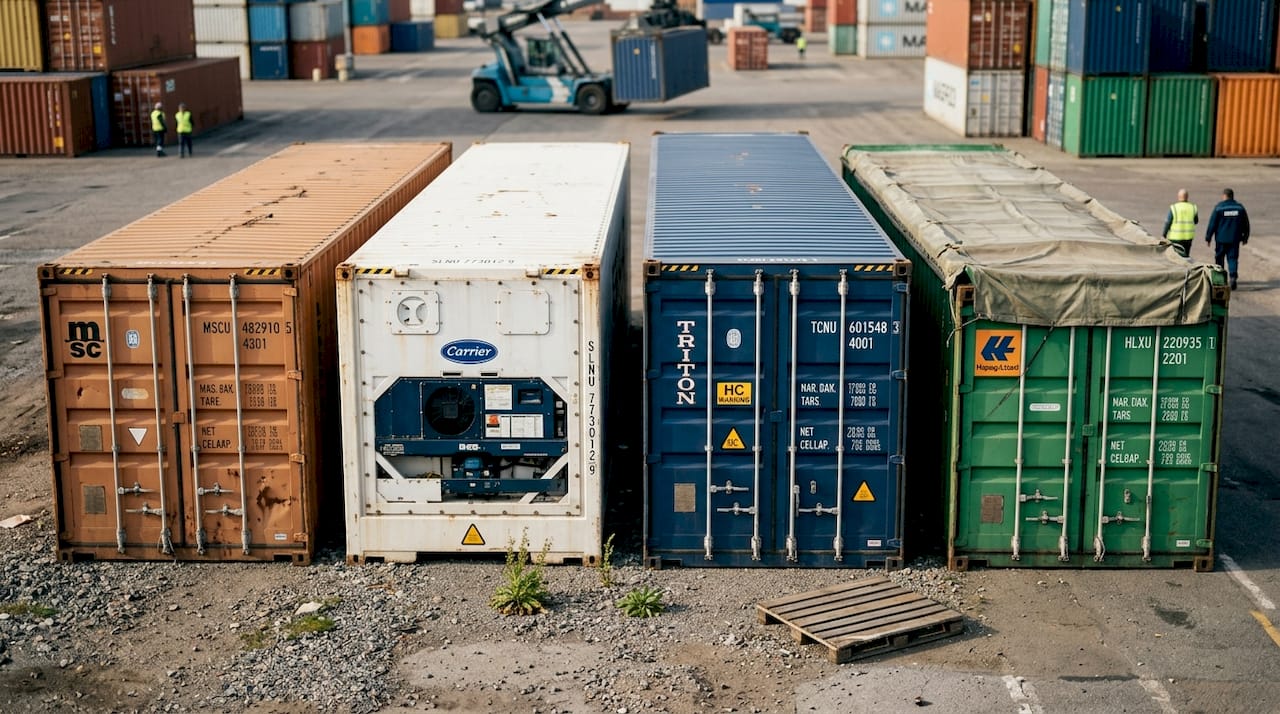
Here’s a quick comparison of the six major container types:
| Container type | Standard size | Best use case | Key feature |
|---|---|---|---|
| Dry standard | 20ft / 40ft | General cargo, storage | Sealed, weatherproof |
| High cube | 40ft HC | Tall or bulky goods | Extra 1ft of interior height |
| Reefer | 20ft / 40ft | Perishables, pharmaceuticals | Temperature controlled |
| Open top | 20ft / 40ft | Oversized or crane-loaded cargo | Removable roof |
| Flat rack | 20ft / 40ft | Heavy machinery, vehicles | Collapsible sides |
| Tank | 20ft | Liquids, chemicals, gases | Cylindrical inner tank |
A high cube container adds roughly one foot of interior height over a standard unit, bringing the internal height to about 8 feet 10 inches versus the standard 7 feet 10 inches. That extra foot matters enormously for palletized goods or tall equipment. A reefer container maintains a controlled temperature range, typically between negative 25 and positive 25 degrees Celsius, making it essential for food, medicine, and certain chemicals.
When selecting a container, consider these factors before committing:
-
Cargo dimensions: Will your goods fit with room to secure them properly?
-
Weight limits: Standard 20ft containers have a max payload of around 28 metric tons
-
Stacking requirements: Not all container types can be stacked safely
-
Transport method: Rail, road, and sea all have different compatibility requirements
-
Temperature sensitivity: Reefer units add cost but are non-negotiable for certain cargo
Key facilities and processes in container logistics
Even when you know your container type and size, the logistics process introduces another layer of terminology that directly affects your costs and timelines.
CY stands for Container Yard. This is the storage area at a port or inland terminal where containers are held before loading or after unloading. CFS, or Container Freight Station, is a warehouse facility where LCL cargo is consolidated or deconsolidated. If you’re shipping LCL, your cargo will pass through a CFS, adding time and handling. Drayage refers to the short-distance trucking that moves containers between a port, rail yard, or warehouse. It sounds minor, but drayage fees and demurrage of $150 to $500 per container per day can stack up fast if scheduling isn’t tight.
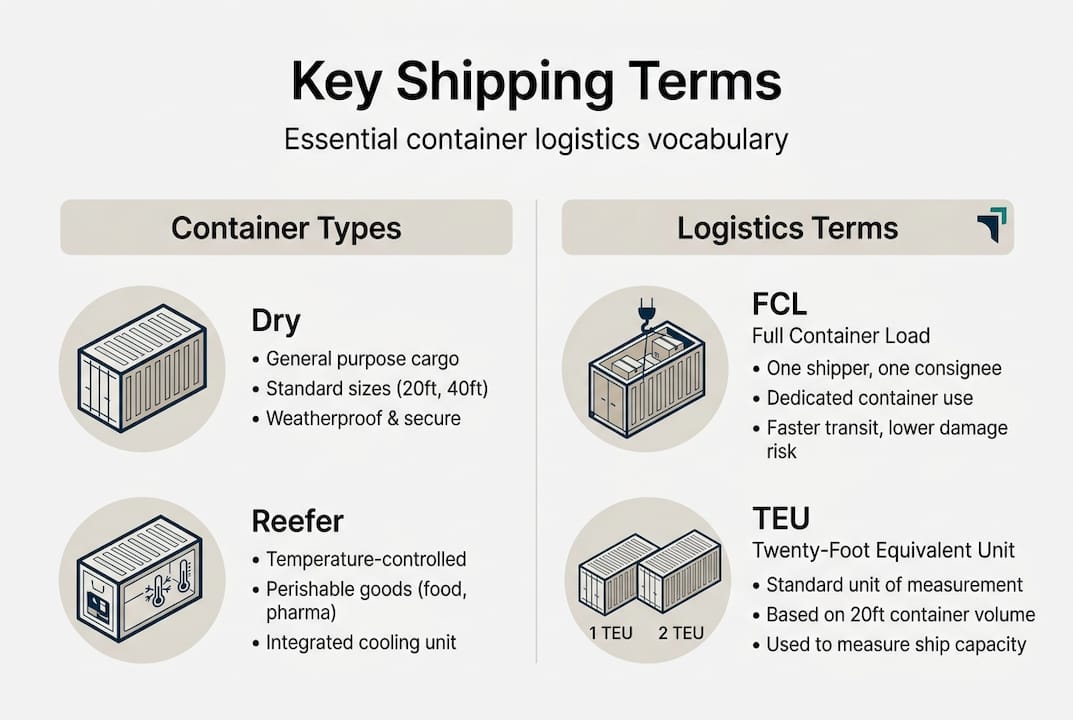
Here’s a real-world look at how those fees accumulate:
| Fee type | Trigger | Typical daily rate | Who charges it |
|---|---|---|---|
| Demurrage | Container held at port past free time | $150 to $500 | Port or terminal |
| Detention | Container kept after port pickup | $150 to $400 | Shipping line |
| Per diem | Container not returned on time | $75 to $200 | Leasing company |
| CFS handling | LCL cargo processing at station | Flat fee per shipment | Freight forwarder |
Understanding the numbered steps in a typical container logistics process helps you anticipate where delays and fees are most likely:
-
Container is booked and assigned a pickup window at the CY
-
Drayage carrier picks up the container and delivers it to your facility
-
You load and seal the container within the allotted free time
-
Container returns to the CY or port for export processing
-
At destination, container enters a new CY and free time clock begins
-
You arrange drayage for delivery and return the empty unit before detention kicks in
Missing step 6 is where most unexpected invoices originate. Port terminals track container movements precisely, and they will bill automatically once free time expires.
Advanced terms: Standards, safety, and international requirements
Once your containers cross borders, a new set of rules applies. These aren’t suggestions. They are enforceable international standards that affect your liability, your cargo’s safety, and your ability to clear customs without delays.
The CTU Code, developed jointly by the IMO, ILO, and UNECE, is the global standard governing how cargo is packed and secured inside containers. CTU Code packing rules focus on load distribution, friction factors, and securement methods to prevent cargo from shifting during transport. A container that’s improperly loaded can become a safety hazard on a vessel or a liability issue at customs.
Here are the critical points every operator should understand:
-
Weight must be distributed evenly across the container floor
-
Heavy items go on the bottom, lighter items on top
-
All cargo must be secured to prevent movement in any direction
-
Blocking, bracing, and lashing must meet friction coefficient requirements
-
Inspection stamps and documentation must accompany cross-border shipments
-
Hazardous materials require additional labeling and segregation rules
“Proper cargo packing and securing under the CTU Code is not just a regulatory formality. It is the single most effective way to prevent cargo loss, container damage, and port-level delays that can derail an entire supply chain.”
Pro Tip: When importing or exporting, always request written documentation confirming CTU Code compliance from your packing team or freight forwarder. If cargo is found non-compliant at a foreign port, the cost of remediation and delays falls on the shipper, not the carrier.
Why mastering industry terms drives better deals and smoother shipping
Here’s something most guides won’t tell you: knowing container terminology isn’t just about avoiding fees. It’s about negotiating power. When you walk into a conversation with a carrier or supplier and use precise language, you signal that you can’t be overcharged through vague contract language.
The most expensive mistakes we see aren’t from new buyers. They’re from experienced project managers who got comfortable with a workflow and stopped questioning the terms on their invoices. Ambiguity around FCL versus LCL gets exploited. Demurrage clocks start ticking while teams wait for internal approval. Safety code declarations get skipped because “it’s always been fine before.”
Terminology also evolves. The CTU Code was updated in recent years, and many operators are still working from outdated assumptions about load securement. Rates change, free time windows shrink, and new container types enter the market. A quick refresh on current standards isn’t a sign of inexperience. It’s exactly what separates operators who run tight, profitable logistics from those who absorb preventable costs quarter after quarter.
Find the right container with expert support
Putting this knowledge into practice starts with working with a supplier who speaks the same language and won’t leave you guessing on specs, compliance, or pricing.
At America Conex, we supply new and used shipping containers across the United States, with access to 30+ depots for fast, reliable delivery. Whether you need a standard 20ft dry unit, a 40ft high cube, or a cargo-worthy container for international shipping, we offer transparent pricing and straightforward support from first inquiry to final delivery. No confusing fees, no vague contracts. Just the right container for your project.
Frequently asked questions
What does TEU mean and why does it matter?
TEU stands for Twenty-foot Equivalent Unit, the industry-standard measurement for container capacity, where a 20ft container equals 1 TEU and a 40ft equals 2 TEU. It simplifies shipment planning and port capacity comparisons across carriers and terminals.
What are common extra charges in container logistics?
Demurrage and detention are the most common surprise charges, with demurrage fees running $150 to $500 per container per day for late port use, and detention fees applying when containers aren’t returned on time after pickup.
What is the difference between FCL and LCL shipments?
FCL means Full Container Load for exclusive use by one shipper, while LCL means Less than Container Load, where your cargo shares space with other shippers’ goods and goes through additional handling at a CFS.
Why is CTU Code compliance important?
CTU Code governs cargo packing and securing under international IMO, ILO, and UNECE standards, reducing the risk of cargo loss and customs delays, particularly for cross-border and ocean shipments.
How can I choose the right container type for my cargo?
Match your container choice to your cargo’s dimensions, weight, temperature needs, and transport method. Container types including Dry, Reefer, High Cube, Open Top, Flat Rack, and Tank cover virtually every commercial shipping and storage requirement.