
TL;DR:
- Proper site preparation is crucial for a smooth shipping container delivery, including assessing access routes, choosing suitable foundations, and clearing obstacles. Ensuring gate widths, overhead clearance, level ground, and private utility marking prevents costly delays and structural issues over time. Detailed planning and communication with suppliers help avoid common mistakes and ensure long-term container functionality.
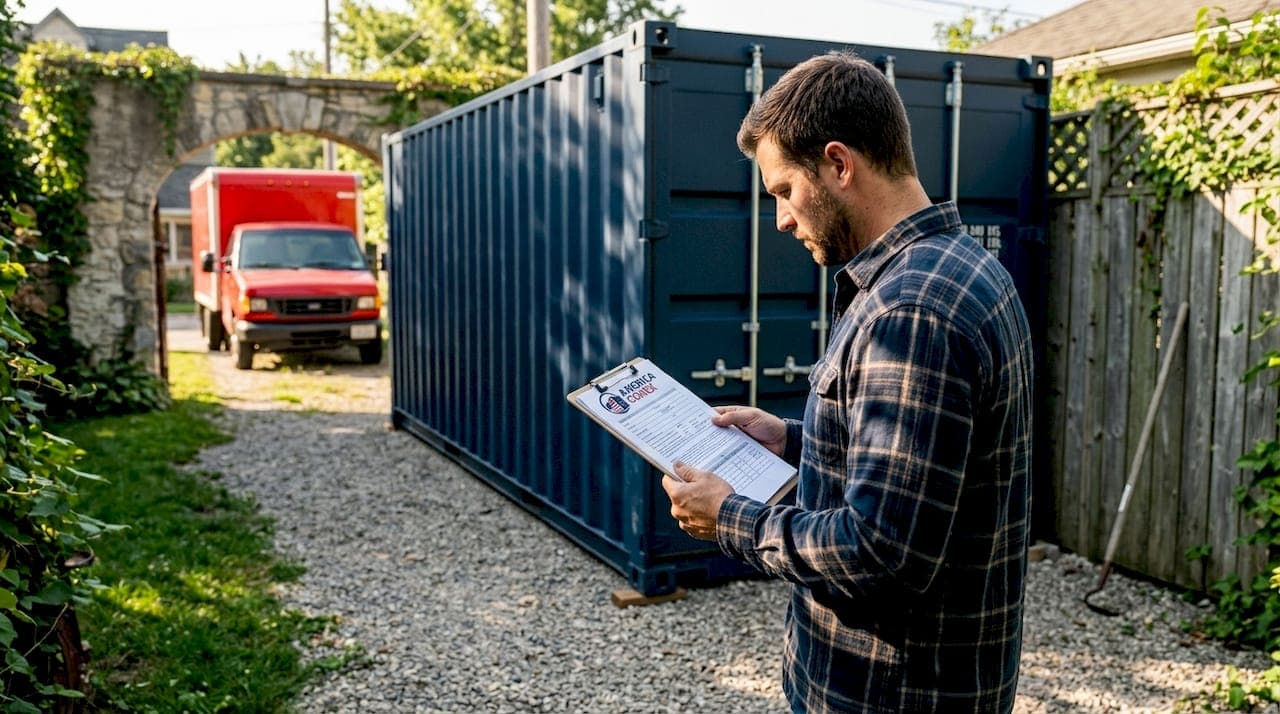
Getting a shipping container delivered sounds straightforward until the truck pulls up and can't get through your gate, or the driver takes one look at your soft, uneven ground and refuses to set the container down. Knowing how to prepare your site for container delivery before the truck arrives is the difference between a smooth 20-minute drop-off and a costly rescheduled delivery. This guide walks you through every step: access route assessment, foundation selection, site clearing, drainage grading, and delivery day coordination, so nothing catches you off guard.
Table of Contents
- Key takeaways
- How to prepare site for container delivery: access routes first
- Ground and foundation prep for stable placement
- Clearing the site footprint and surrounding area
- Delivery day coordination and final checks
- My honest take on where most site preps go wrong
- Ready to order? Americaconex makes delivery straightforward
- FAQ
Key takeaways
| Point | Details |
|---|---|
| Access routes matter first | Gates must be at least 12 to 14 feet wide with 14 feet of overhead clearance for delivery trucks. |
| Level ground prevents door problems | A side-to-side slope greater than 1 inch causes door binding and misalignment after placement. |
| Compacted gravel is your best value | A 4 to 6-inch compacted gravel base provides drainage and load support at the lowest cost. |
| Private utilities are your responsibility | Calling 811 only marks public utility lines. You must locate and mark private lines yourself. |
| Door clearance affects daily use | Allow at least 4 to 5 feet in front of container doors for full swing and practical access. |
How to prepare site for container delivery: access routes first
Before you think about foundations or site clearing, ask yourself one question: can the truck actually get there? This step is the most overlooked part of site preparation for containers, and it creates the most expensive delays when ignored.
Delivery trucks require a minimum gate or entrance width of 12 to 14 feet and at least 14 feet of overhead clearance to pass safely. That means tree branches, power lines, fences, and low-hanging structures all need to be assessed before you schedule a delivery. A standard tilt-bed truck with a loaded container is 50 to 70 feet long. If your property has sharp turns, tight driveways, or narrow access roads, the driver may not be able to complete the delivery at all.
Beyond the entrance, the surface condition of your access route matters just as much. Hard-packed gravel and paved surfaces handle loaded truck weight well. Soft, muddy, or waterlogged soil is a different story. A fully loaded 40-foot container can weigh over 30,000 pounds, and if the truck sinks into soft ground along the approach, you have a much bigger problem than a delayed delivery.
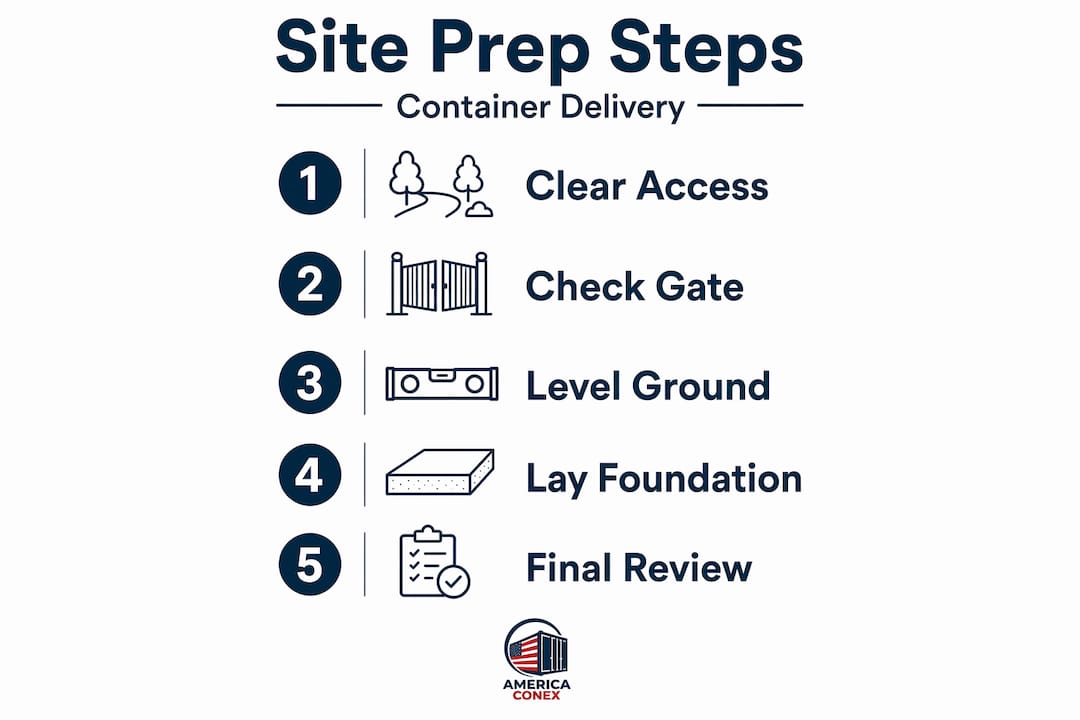
Here is what to check when assessing your access route:
- Gate and entrance width: Measure the narrowest point, not just the gate opening. Account for fence posts, pillars, or any fixed obstruction.
- Overhead clearance: Check for tree canopy, utility lines, and low roof overhangs along the entire approach path.
- Surface stability: Identify any soft patches, wet areas, or loose fill along the route that could give way under truck weight.
- Turn radius: Mark any turns tighter than 45 degrees and discuss them with your supplier before booking delivery.
- Approach path length: A tilt-bed truck needs 50 to 100 feet of clear, straight path at the placement area. A 40-foot container requires the longer end of that range.
Pro Tip: Take photos and a short video of your entire access route from the street to the placement area, then send them to your supplier. It takes five minutes and eliminates the most common delivery day miscommunications.
Ground and foundation prep for stable placement
Soft ground causes containers to sink. Uneven ground causes door problems. Poor drainage causes corrosion. All three issues are preventable with proper foundation work, and all three are expensive to fix after the fact.
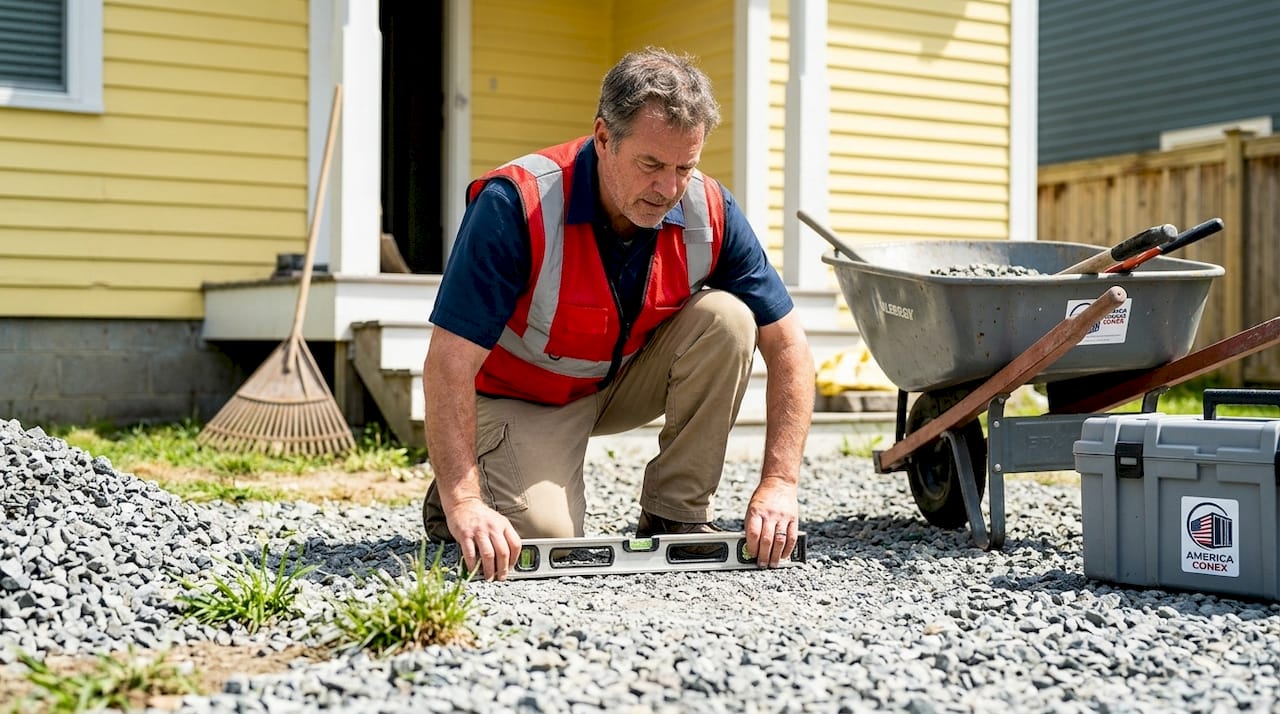
The ground must be firm and level, with no more than 1 inch of side-to-side slope across the container's width. Beyond that threshold, the container frame begins to rack, and the doors bind. You will find yourself fighting to open or close them every single day the container sits on that spot. Minor slopes are manageable with steel or hardwood shims placed under the corner castings before or during placement, but that only works within a small margin.
Your choice of foundation comes down to three practical options, each suited to different budgets and site conditions:
| Foundation type | Approximate cost | Best for | Notes |
|---|---|---|---|
| Compacted gravel base | Low | Most property types | 4 to 6 inches deep; excellent drainage; easy to install |
| Concrete corner pads | Medium | Long-term or permanent placement | Poured at four corners; very stable; requires curing time |
| Timber or steel beams | Low to medium | Rural or temporary use | Provides elevation; can be repositioned; check for rot over time |
| Full concrete slab | High | Commercial or permanent installs | Maximum stability; highest cost and prep time |
Compacted gravel at 4 to 6 inches deep is the go-to foundation for most property owners. It distributes the container's weight across a wide area, and it drains water away from the steel base rails. That drainage piece is non-negotiable. A minimum 2% slope graded away from the container base prevents water from pooling under the structure. Standing water accelerates corrosion on the bottom rails, and that damage is invisible until it becomes serious.
Never place a container directly on bare or soft soil, particularly clay-heavy or wet ground. Clay holds moisture, expands when wet, and causes uneven settling over time. What starts as a barely noticeable tilt in year one becomes a significant structural and access problem by year three.
Pro Tip: If your site is nearly level but not quite, have steel shims or hardwood blocking on hand before the truck arrives. The driver can often adjust placement slightly, but they cannot wait while you search for materials.
For a detailed breakdown of foundation costs and installation steps, the container foundation guide from Americaconex covers each option in depth.
Clearing the site footprint and surrounding area
Once your foundation plan is set, your next task is preparing the physical footprint where the container will sit, plus the zone around it. This step is about more than aesthetics. Debris, vegetation, rocks, and unmarked underground lines all create real problems during delivery and over the container's lifetime.
Start by clearing the exact placement area plus several feet in every direction. Remove rocks, stumps, overgrown grass, brush, and any loose fill material. The ground under and around the container needs to be stable and clean before your foundation material goes down.
Before any digging, grading, or ground disturbance, call 811. This free service marks utility lines owned by member companies in your area. However, 811 does not mark private lines like private irrigation systems, septic laterals, or privately run electrical or data lines. As the property owner, you are legally responsible for locating those. Hire a private utility locator if you are unsure. Damaging a private line during site prep creates liability and repair costs that far exceed the cost of a locator service.
Beyond underground concerns, think carefully about door clearance and orientation when you choose your placement spot. Container doors require at least 4 to 5 feet of open space in front of them for a full 270-degree swing. If the doors open toward a fence, wall, or another structure with less clearance than that, you will never be able to fully open them. That limits your ability to load wide items and reduces daily functionality significantly.
A few other considerations worth planning into your site footprint:
- Orientation for sunlight and airflow: Positioning doors on the shaded side reduces heat buildup in storage containers. In hot climates, this is worth thinking through before placement rather than after.
- Marking the exact spot: On delivery day, use spray paint, stakes, or flags to mark precisely where the container should sit. Drivers appreciate clear visual targets, especially on large or complex properties.
- Safety during site prep: Keep other people and vehicles away from the active work zone during grading, excavation, or material delivery. Review warehouse and site safety practices when transitioning from prep to operation.
Delivery day coordination and final checks
Everything covered so far sets the stage. Delivery day is where it either comes together cleanly or reveals the gaps in your prep. Most delivery problems at this stage are communication failures, not physical site failures.
The week before delivery, confirm directly with your supplier that the driver has your access route details, any site constraints, and the precise placement location. Do not assume information passed at the time of order is still top of mind for the driver. Confirm again.
On delivery day itself, work through this checklist before the truck arrives:
- Clear the entire access route of parked vehicles, equipment, and movable obstacles.
- Unlock and open all gates to their maximum width.
- Verify the placement area is clear and the spot is visibly marked.
- Check that the approach path in front of the placement zone is clear for the full tilt-bed maneuver.
- Have shims or blocking material staged near the site if leveling adjustments are needed.
- Be physically present at the site and available to direct the driver.
If your site has serious space constraints and a standard tilt-bed truck cannot complete the delivery, a crane or specialized placement equipment may be required. Discuss this with your supplier in advance. Same-day crane arrangements are expensive and often unavailable. Building that into your plan early saves real money.
The container delivery planning guide from Americaconex walks through the logistics side of delivery coordination in more detail if you want to go deeper on the process.
My honest take on where most site preps go wrong
I have reviewed a lot of container placements, and the same issues come up repeatedly. Most property owners focus on the container itself, and they treat site prep as a checkbox rather than a process. That mindset is what leads to the problems.
The two issues I see most often are drainage and private utilities. People grade the foundation reasonably well and then ignore the slope away from the container entirely. That 2% drainage grade is not optional. Neglecting it is the single fastest way to shorten a container's useful life, and the damage happens underground, out of sight, until it is already significant.
The private utility issue is even more avoidable. People call 811, feel covered, and start digging. But 811 only marks member-owned utilities, not private lines. I have seen properties where irrigation systems, private electrical runs, and even old septic lines were unmarked. That is not the utility company's problem. It is yours.
My other consistent observation is that people underestimate how much foundation choice affects long-term cost. Compacted gravel is genuinely excellent for most situations. A full concrete slab is often overkill for a single storage container. The decision should be driven by how long the container stays and whether it will be moved. For anything temporary or potentially repositioned within a few years, gravel or timber beams are the smarter play. For a permanent commercial installation, invest in concrete.
Plan door clearance before placement, not after. Moving a placed container because the doors swing into a wall costs time and money that a few extra minutes of planning would have avoided entirely.
— Alex
Ready to order? Americaconex makes delivery straightforward
Once your site is prepped and ready, the next step is selecting the right container. Americaconex offers new and used shipping container grades ranging from one-trip units in like-new condition to wind and water tight options for cost-effective storage. Before finalizing your foundation dimensions and placement spot, check the exact container size options for 20-foot and 40-foot standard and high cube units so your site prep matches your container precisely.
With access to 30 or more depots nationwide, Americaconex delivers fast and competitively to nearly any location in the United States. The team can advise on site constraints, access requirements, and container selection before you schedule delivery. Reach out to Americaconex directly to get a quote and make sure your site prep and your container order are fully aligned from day one.
FAQ
What width does a gate need to be for container delivery?
Gates need at least 12 to 14 feet of clear width and 14 feet of overhead clearance for a delivery truck to pass safely with a container loaded.
What is the best foundation for a shipping container?
Compacted gravel at 4 to 6 inches deep is the most practical and cost-effective base for most properties, offering good drainage and solid load distribution. Concrete pads or a full slab suit permanent or commercial placements. Learn more about comparing options on the foundation types guide.
Why does level ground matter so much for containers?
A slope over 1 inch across the container's width causes the steel frame to rack, which leads to door misalignment and binding that worsens over time.
Does calling 811 cover all underground utilities?
No. The 811 service marks member-owned utilities only. Private lines such as irrigation, septic laterals, and privately run electrical are not included. Property owners are responsible for locating these before any ground disturbance.
How much space do container doors need to open?
Containers require at least 4 to 5 feet of clear space directly in front of the door end for a full 270-degree swing. Less than that and the doors cannot open completely, limiting access for loading and unloading.