

TL;DR:
- Buying a shipping container involves understanding condition grades, delivery logistics, and total costs to avoid surprises. Proper inspection and clear communication with sellers ensure the container meets your intended use, whether for storage or shipping. Careful planning of site preparation, delivery, and accurately calculating the full landed cost lead to a smooth purchase and setup process.
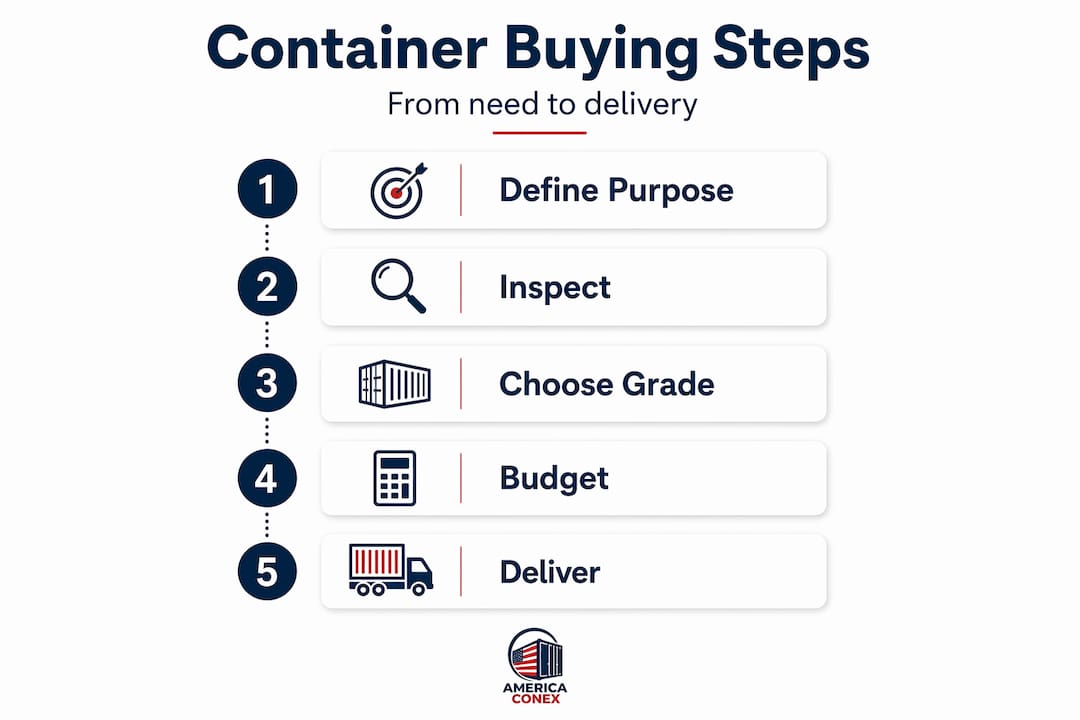
Buying a shipping container looks simple at first glance. You pick a size, get a price, and wait for delivery. But the real process involves condition grades, delivery logistics, site preparation, and a handful of costs that never show up in the advertised price. First-time buyers often get caught off guard by these details, and even experienced buyers make costly mistakes when they skip key steps. This guide walks you through every stage of the container buying process so you know exactly what to expect, what questions to ask, and how to avoid the surprises that derail most purchases.
Table of Contents
- Understanding your needs and intended use
- Stage 1: Research and inspection—what to look for
- Stage 2: Choosing the right grade and condition
- Stage 3: Budgeting for the true landed cost
- Final steps: Transaction, delivery, and site setup
- Our perspective: What most container buyers overlook (and what really matters)
- Find the right container—shop with confidence
- Frequently asked questions
Key Takeaways
| Point | Details |
|---|---|
| Know your use case | Defining your container's purpose informs every stage from grade selection to delivery. |
| Inspect before you buy | A container's visible condition and grade directly impact its value and performance. |
| Budget for total cost | Include delivery, offloading, and site prep in your budget, not just the sticker price. |
| Plan delivery logistics | Ensure your site is ready and delivery responsibilities are clear before finalizing the purchase. |
Understanding your needs and intended use
Before you look at a single container listing, you need to get clear on why you're buying one. This sounds obvious, but it shapes every decision that follows, including which grade you need, how much you should spend, and what delivery setup makes sense.
Ask yourself these core questions:
- Are you storing tools, equipment, or inventory on a job site?
- Do you need weatherproof storage on a residential property?
- Are you shipping goods internationally?
- Do you need a modified container (with doors, windows, or electrical)?
- Is this a permanent installation or a temporary setup?
Your answers determine everything. A homeowner storing seasonal equipment has completely different needs from a logistics company moving freight across the Pacific. As container uses guide explains, standard containers serve a wide range of purposes, and matching the right unit to your application saves you money and frustration.
For residential container storage, a Wind & Watertight (WWT) unit is often the most cost-effective choice. For international shipping, you need a Cargo Worthy (CW) certified container. The container grades you choose based on intended use directly affect price range, legal requirements, and long-term performance.
Pro Tip: Write down your top three priorities before shopping. Is it price, condition, or delivery speed? Knowing your priorities prevents you from getting talked into a container that doesn't actually fit your situation.
Stage 1: Research and inspection—what to look for
Once you know your intended use, the next step is evaluating container quality. This is where many buyers make their first mistake: they trust a listing photo and skip the inspection. That shortcut can cost thousands.
A proper inspection covers these key areas:
- Exterior walls and roof: Look for rust patches, dents, or holes. Surface rust is common and manageable. Deep rust that has eaten through the steel is a red flag.
- Floor condition: Wooden floors should be solid, without soft spots or rot. Check for chemical stains if you're storing food or sensitive equipment.
- Door seals and hardware: Doors should open and close smoothly. Seals should be intact and free of cracks. A failed door seal means water gets in.
- Interior smell: A strong chemical odor can indicate the container previously carried hazardous materials.
- Watertightness: On a sunny day, close yourself inside and look for light coming through. Any light means water can get in.
Many sellers will provide condition photos or allow in-person inspections at the depot. Always request this. If a seller refuses to provide photos or access, that's a warning sign.
"Buyers must choose the right grade and condition level based on intended use, whether that's storage, international shipping, or weatherproofing. Each grade carries distinct implications for performance and cost."
For deeper guidance on what to look for, the container quality tips resource covers the most common issues buyers encounter during inspection. And if you're new to the terminology, brushing up on shipping container terms before you start shopping will help you ask the right questions and understand seller responses.
Stage 2: Choosing the right grade and condition
With your inspection knowledge in hand, selecting the right grade is the next critical decision. Container grades are not just marketing labels. They carry real implications for what you can legally do with the container, how long it will last, and how much you'll pay.
Here's a clear breakdown of the four main grades:
| Grade | Condition | Best for | CSC certified? | Relative cost |
|---|---|---|---|---|
| One-Trip | Like-new, minimal wear | Premium storage, modifications | Yes | Highest |
| Cargo Worthy (CW) | Used, structurally sound | International shipping, storage | Yes | Mid-high |
| Wind & Watertight (WWT) | Used, weatherproof | Domestic storage, job sites | No | Mid |
| As-Is | Varies, no guarantees | Budget projects, parts | No | Lowest |
The container grades system exists because not every container needs to meet international shipping standards. WWT containers are weather-tight but not certified for intermodal freight. CW containers carry a CSC (Container Safety Convention) plate, which is required for international shipment. As-Is containers may have significant structural issues and come with no guarantees.
Key factors to weigh when choosing your grade:
- Budget: One-Trip units cost more upfront but require less maintenance over time.
- Legal requirements: If you're shipping internationally, CW is not optional.
- Modification plans: One-Trip containers are easier to cut and modify cleanly.
- Timeline: WWT containers are widely available and often faster to source.
For a detailed look at what Cargo Worthy certification means in practice, the cargo worthy containers guide breaks down the inspection process and what the CSC plate actually guarantees.
Pro Tip: Don't automatically buy the cheapest grade. A WWT container that leaks after six months of rain will cost more in damaged inventory than the price difference between WWT and CW would have been.
Stage 3: Budgeting for the true landed cost
Here's where most buyers get an unpleasant surprise. The price you see advertised is almost never what you'll actually pay. The landed cost is the total amount you spend to get a container sitting on your property, ready to use. It includes several components that add up fast.
| Cost component | Typical range | Notes |
|---|---|---|
| Base container price | $1,500 to $6,500+ | Varies by grade, size, and market |
| Delivery fee | $300 to $2,500+ | Distance from depot is the main driver |
| Offloading (if needed) | $150 to $500+ | Crane or forklift rental if tilt-bed isn't possible |
| Site preparation | $0 to $1,500+ | Gravel pad, concrete, or leveling |
| Permits (if required) | $50 to $500+ | Varies by city and county regulations |
The landed cost calculation is something every buyer needs to work through before committing. Delivery distance from the nearest depot is the biggest variable. Rural deliveries or locations with difficult access can push delivery fees well above $2,500.
Site accessibility matters more than most buyers realize. If a standard tilt-bed truck can't reach your drop location, you'll need a crane or specialized equipment, which adds cost and scheduling complexity. Overhead obstacles like power lines, tree branches, and low-clearance gates can all create problems on delivery day.
Permits are another overlooked expense. Some municipalities require a permit for any container placed on a property, even temporarily. Check with your local zoning office before you buy.
For practical strategies to reduce your total spend, the saving on container costs guide covers negotiation tactics and timing strategies. And if you're weighing different delivery methods, container transport options explains the tradeoffs between tilt-bed, flatbed, and crane delivery.
Pro Tip: Always ask your supplier for an all-in quote that includes delivery to your specific address. A price that looks great online can change significantly once your zip code and site conditions are factored in.
Final steps: Transaction, delivery, and site setup
You've done your research, selected your grade, and calculated your landed cost. Now it's time to execute. This final stage is where attention to detail pays off.
Follow these steps to ensure a smooth delivery and setup:
- Confirm your site is ready. The ground should be level and firm enough to support the container's weight. A gravel pad or concrete foundation is ideal. Soft or uneven ground can cause the container to rack (twist out of square), which makes doors hard to open.
- Verify access for the delivery truck. Measure your driveway width, overhead clearance, and turning radius. A standard tilt-bed truck needs roughly 100 feet of clear space to operate safely.
- Confirm delivery details in writing. Get the delivery date, time window, driver contact, and offloading method confirmed before you pay in full.
- Arrange offloading equipment if needed. If your site can't accommodate a tilt-bed drop, arrange a forklift or crane in advance. Don't assume the delivery driver will handle it.
- Inspect the container on arrival. Before the driver leaves, walk around the container and check it against your order. Note any damage or discrepancies in writing and take photos immediately.
- Check all doors and seals. Open and close every door. Check the seal condition. If something is wrong, it's far easier to resolve before the driver leaves than after.
As delivery cost data confirms, delivery fees range from $300 to $2,500 or more depending on distance and access. Planning your site setup around the delivery method saves you from expensive last-minute changes.
For a complete walkthrough of how to set up your container for maximum utility, the container storage setup guide covers layout, ventilation, and workflow considerations.
Pro Tip: Take a short video walkthrough of the container immediately after delivery. This creates a timestamped record of its condition that protects you if any disputes arise later.
Our perspective: What most container buyers overlook (and what really matters)
We've helped thousands of buyers across the country, and the pattern is consistent. The buyers who have the smoothest experiences are not necessarily the ones who spent the most. They're the ones who asked the right questions before they paid.
The biggest mistake we see is treating the advertised price as the total cost. A container listed at $1,800 with a $1,200 delivery fee and $600 in site prep is a $3,600 purchase. Buyers who don't run those numbers end up frustrated, feeling like they were misled, even when the pricing was technically transparent.
The second most common mistake is buying the cheapest container available without asking why it's cheap. As-Is containers are priced low for a reason. Sometimes that reason is minor cosmetic damage. Sometimes it's a floor that needs full replacement or a door that won't seal properly. The repair cost can easily exceed the savings.
What really separates a good container purchase from a frustrating one is the conversation you have before you commit. Ask your supplier these questions:
- What is the exact condition of this specific container?
- Can you provide photos of the interior floor and door seals?
- What is the delivery fee to my address, and what does it include?
- Who is responsible for offloading, and what equipment will be used?
- Are there any known repairs or issues I should be aware of?
A supplier who answers these questions clearly and without hesitation is a supplier worth working with. Vague answers or pressure to decide quickly are red flags.
We also see buyers underestimate the importance of efficient site storage planning. A container placed in the wrong spot, or on ground that wasn't properly prepared, creates daily inconvenience and potential structural issues over time. Spending an extra hour planning the placement saves months of frustration.
The container buying process rewards preparation. Do the work upfront, and the rest of the process is straightforward.
Find the right container—shop with confidence
Knowing the stages of a container purchase puts you in a much stronger position to buy smart. At America Conex, we make it easy to move from research to delivery without the usual guesswork.
We offer a full range of shipping containers for sale, including One-Trip, Cargo Worthy, and Wind & Watertight units in 20ft and 40ft sizes, both standard and high cube. With 30+ depots nationwide, we can deliver quickly and competitively to most locations across the U.S. Our team is ready to walk you through grade selection, delivery logistics, and site prep questions so you get the right container at the right price, with no surprises.
Frequently asked questions
How do I choose the right shipping container grade?
Select your grade based on intended use. One-Trip is best for like-new quality, Cargo Worthy is required for international shipping, Wind & Watertight works well for domestic storage, and As-Is offers the lowest price but the least reliability. As container grade guidance confirms, matching grade to use case is the most important buying decision you'll make.
What hidden costs can surprise first-time container buyers?
Delivery, offloading, and site preparation often add $300 to $2,500 or more beyond the base container price, and permits can add further costs depending on your location. The full landed cost is always higher than the advertised price, so budget accordingly.
Can I inspect a container before buying?
Yes. Many sellers offer in-person depot inspections or will provide detailed condition photos upon request. Always ask for interior shots of the floor, door seals, and roof before committing to a purchase.
How long does it take to deliver a container after purchase?
Delivery timelines typically range from a few days to two weeks, depending on depot proximity, carrier availability, and local logistics. Buyers in rural areas or with complex site access may experience longer lead times.