

TL;DR:
- Container grades are standardized categories indicating a container’s condition for safe, legal, and suitable use. Understanding differences between New 1-Trip, Cargo Worthy, WWT, and As-Is containers helps buyers match their needs, from international shipping to storage or conversions. Verification through documented inspection standards like IICL-6 and inspection of physical features ensures accurate grading and prevents costly mistakes.
Container grades are standardized quality and condition categories that determine whether a shipping container is fit for international transport, secure storage, or conversion projects. Choosing the wrong grade costs money, delays shipments, and creates real safety risks. This guide to container grades covers every classification you will encounter, from factory-fresh one-trip units to as-is containers sold without guarantees, along with the inspection standards behind each label and the practical steps to verify what you are actually buying.
What are the main types of container grades and what do they mean?
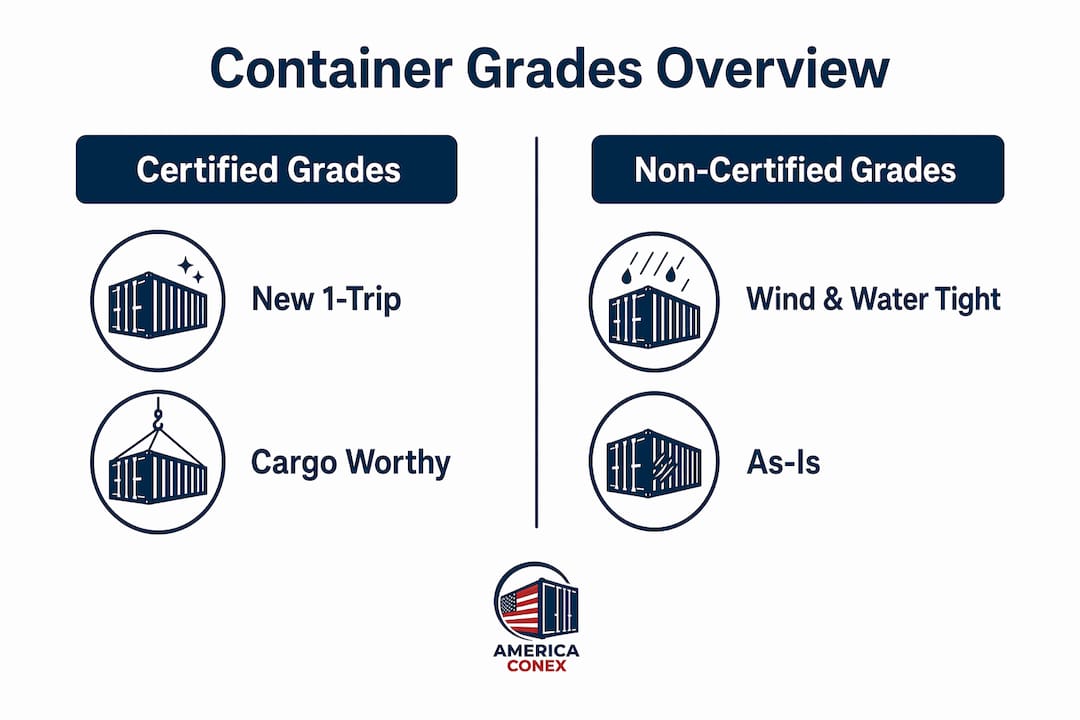
The four main container grades are New 1-Trip, Cargo Worthy, Wind and Water Tight (WWT), and As-Is. Each reflects a distinct condition level and a different set of acceptable uses. Understanding this terminology of container grades before you buy protects you from paying a premium price for a container that cannot legally carry cargo.
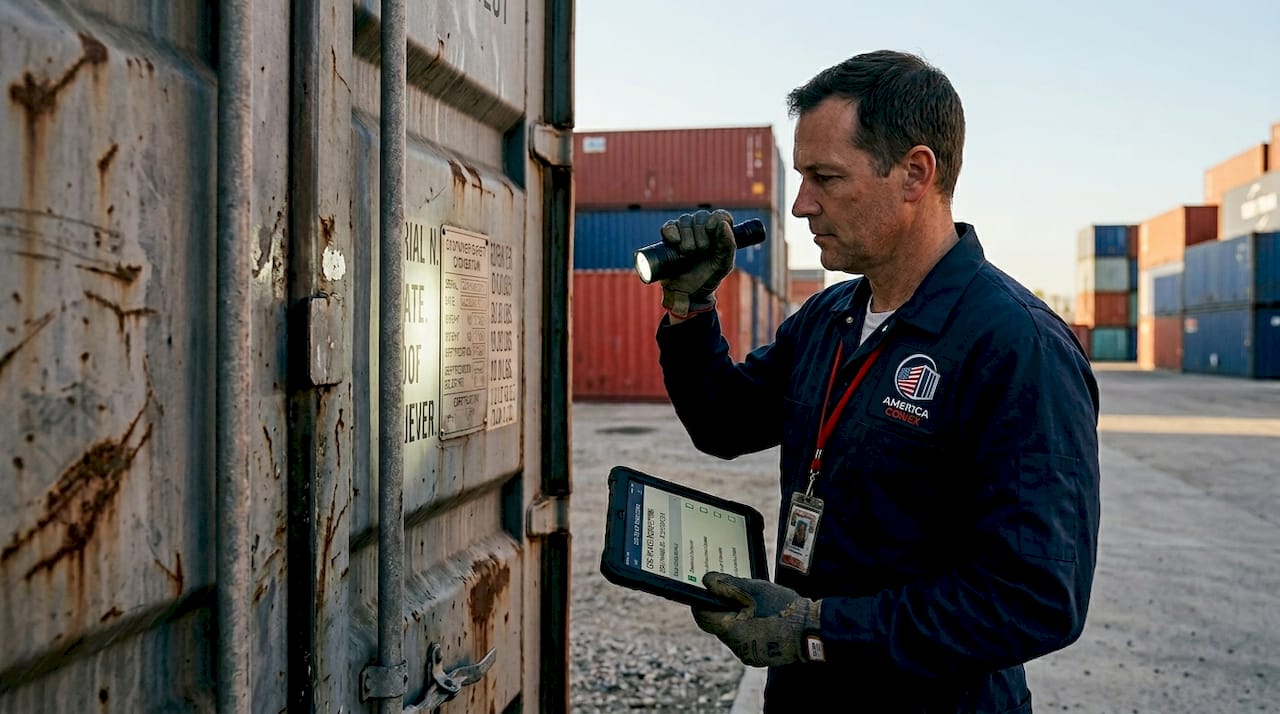
New 1-Trip containers are manufactured overseas, loaded once with goods shipped to the United States, and then sold. They carry no rust, no dents worth mentioning, and no wear on the floor or door seals. For buyers who need a container that looks and performs like new without paying the full factory price, a one-trip unit is the closest available option.
Cargo Worthy containers are the workhorse of the used market. A Cargo Worthy container carries certification confirming it meets structural and safety requirements for international shipping. That certification is not a marketing label. It reflects a passed inspection against documented criteria covering doors, floors, walls, roof, and corner castings.
Wind and Water Tight containers provide a weather-resistant enclosure but carry no shipping certification. WWT containers may have structural issues that disqualify them for international cargo, making them well suited for on-site storage but not for loading onto a vessel. The price difference between WWT and Cargo Worthy is real, and so is the functional difference.
As-Is containers are sold exactly as found, with no inspection guarantee and variable structural integrity. They are the lowest grade available and carry the highest risk of hidden defects. As-Is units work for scrap, art projects, or heavily modified builds where structural certification is irrelevant, but they should never be used for shipping or unmodified storage of valuable goods.
| Grade | Condition | Certified for shipping | Best use |
|---|---|---|---|
| New 1-Trip | Like new, minimal wear | Yes | Shipping, storage, conversion |
| Cargo Worthy | Used, structurally sound | Yes | International shipping, storage |
| Wind and Water Tight | Used, weather-resistant | No | On-site storage only |
| As-Is | Variable, no guarantee | No | Modification, scrap, low-risk storage |
Pro Tip: Grade names vary by seller. "Cargo Worthy" may appear as "CW," "cargo-worthy," or "shipping-grade." Always ask for the specific inspection standard behind the label, not just the name.
How are container grades determined: inspection criteria and standards?
Container grading is not a matter of opinion. It follows documented inspection standards with measurable pass-fail thresholds. The most widely referenced framework is IICL-6, which was implemented worldwide on August 1, 2016, and defines component-by-component repair versus reject criteria for structural condition and appearance. IICL-6 is stricter than general Cargo Worthy or WWT classifications, making it the benchmark for export-ready containers.
Beyond IICL-6, the industry uses several overlapping standards. Container inspection criteria include IICL-6 for on-hire and off-hire inspections, UCIRC Rev 3 for steel general-purpose containers, CIC (which harmonized with IICL-6 in 2016), and CSC examination, which requires a safety exam within five years of manufacture and every 30 months after that. Each standard governs a different scope, but all share the goal of confirming that a container can safely carry cargo without failing in transit.
A Cargo Worthy inspection checks the following specific conditions:
- Doors: Full function, no binding, seals intact and watertight
- Floor: No rot, no penetrating damage, boards structurally sound
- Roof: No holes, no corrosion penetrating the steel envelope
- Walls and panels: Minor dents acceptable, no cracks or tears
- Corner castings: Sound, no cracks, correctly aligned for stacking
- CSC plate: Valid, legible, and within the required inspection cycle
The CSC plate is the physical proof that a container has passed a safety examination under the International Convention for Safe Containers. Cargo Worthy certification requires a valid CSC plate, and without one, a container cannot legally be loaded for international shipping regardless of its physical condition.
Photographic documentation linked to the container number is the standard for defensible compliance. Reputable sellers maintain structured photo records for every inspected unit. If a seller cannot provide documentation tied to a specific container number, treat the grade claim as unverified.
Pro Tip: When sourcing a container for export, ask the seller directly whether the unit is IICL-6 compliant. IICL-6 compliance confirms stacking strength, service life criteria, and export readiness in a single standard, which general "Cargo Worthy" labeling does not always guarantee.
Which container grades are best suited for shipping, storage, or conversion?
Matching the right grade to the right job is where most buyers make costly mistakes. The container grade differences between Cargo Worthy and WWT, for example, are invisible to the eye but legally significant at a port. Here is how to think about grade selection by use case.
For international shipping, only Cargo Worthy or IICL-6 compliant containers qualify. Cargo Worthy certification is necessary to pass international shipping requirements and avoid cargo blocks at ports. A WWT container loaded onto a vessel without certification exposes the shipper to fines, cargo holds, and liability for any damage in transit.
For on-site storage, WWT containers are the practical choice for most buyers. They keep contents dry and secure, cost less than Cargo Worthy units, and perform reliably for years when positioned correctly. A construction company storing tools on a job site does not need a CSC plate. It needs a weatherproof box, and WWT delivers that at a lower price point.
For conversion projects such as offices, retail pop-ups, or homes, a one-trip or Cargo Worthy container gives the best starting point. The structural integrity of a higher-grade container means fewer surprises when cutting openings for windows and doors. As-Is containers introduce unknown variables that can add significant cost to a conversion build.
Use case summary:
- International shipping: Cargo Worthy or IICL-6 compliant only
- Long-term storage: WWT or Cargo Worthy, depending on budget
- Short-term job site storage: WWT is sufficient
- Conversion or modification: New 1-Trip or Cargo Worthy recommended
- Budget storage with low-value contents: As-Is may be acceptable with a physical inspection
Pro Tip: Always confirm that the grade you are purchasing matches your actual intended purpose before signing. A WWT container purchased for storage that you later decide to ship will require a full re-inspection and possible repairs before it qualifies as Cargo Worthy.
How to evaluate container grade when buying: practical tips and common pitfalls
Sellers use grade labels loosely. "Good condition," "storage-ready," and "like new" are marketing descriptions, not inspection grades. The only way to verify container grade specifications is to check the documentation and inspect the physical unit. Follow these steps before committing to a purchase.
- Request the inspection report. Ask for a written inspection report tied to the specific container number. A reputable seller provides this without hesitation.
- Verify the CSC plate. Locate the CSC plate on the door end of the container. Check the manufacture date and the most recent examination date. If the plate is missing or expired, the container is not certified for shipping.
- Check the door seals. Open and close both doors fully. The rubber gaskets should compress evenly with no gaps. Light leaking around the door frame is a red flag.
- Inspect the floor. Walk the full length of the floor and check for soft spots, rot, or damage. Hardwood floors in older containers are prone to moisture damage that is not visible from outside.
- Look at the roof from inside. Stand inside with the doors closed. Any pinhole light indicates a penetration in the steel roof, which disqualifies the container from WWT status.
- Examine the corner castings. Run your hand along each corner casting and look for cracks or deformation. Damaged castings affect stacking safety and are a structural failure point.
- Cross-reference the container number. The container number on the CSC plate, the door, and any documentation should all match. Mismatches suggest the documentation belongs to a different unit.
| Defect found | Grade impact |
|---|---|
| Expired CSC plate | Disqualifies from Cargo Worthy |
| Roof pinhole or penetration | Drops to As-Is or below WWT |
| Soft or rotted floor boards | Fails Cargo Worthy floor criteria |
| Cracked corner casting | Structural failure, disqualifies all grades |
| Minor surface rust | Acceptable for WWT and Cargo Worthy |
| Door seal gap | Fails WWT weather-resistance standard |
For buyers who cannot inspect in person, Americaconex provides container features and condition details for each unit, along with transparent grade listings that reflect actual inspection status rather than marketing language. Reviewing a seller's grading standards before purchase is as important as reviewing the container itself. You can also review the buying process step by step to know exactly what to expect.
Key takeaways
Choosing the correct container grade requires matching documented inspection standards to your specific use case, not relying on seller descriptions alone.
| Point | Details |
|---|---|
| Four recognized grades | New 1-Trip, Cargo Worthy, WWT, and As-Is each serve distinct purposes and carry different certifications. |
| IICL-6 is the strictest standard | IICL-6 compliance confirms export readiness, stacking strength, and service life beyond general Cargo Worthy labeling. |
| CSC plate is non-negotiable for shipping | A valid CSC plate is required for international cargo; without it, no container qualifies regardless of physical condition. |
| WWT is storage-only | WWT containers provide weather protection but lack the certification required for loading onto a vessel. |
| Documentation beats descriptions | Always request an inspection report tied to the container number before purchasing any grade above As-Is. |
What I've learned from watching buyers get the grade wrong
The most common mistake I see is buyers treating grade labels as interchangeable. Someone needs a container for storage, gets quoted a "Cargo Worthy" price, then finds a "WWT" unit for less and assumes it is basically the same thing with a different name. It is not. The gap between those two grades is the difference between a container that has passed a documented structural inspection and one that has not.
The second mistake is trusting visual condition over documentation. A container can look clean and solid and still carry an expired CSC plate, a cracked corner casting hidden under paint, or a floor that has been patched rather than replaced. I have seen buyers skip the inspection report because the container looked good in photos, only to discover problems after delivery. At that point, the cost of repairs often exceeds the savings from choosing a cheaper grade.
Grade also affects long-term cost in ways buyers underestimate. A Cargo Worthy container with solid documentation holds its resale value. A WWT unit that develops a roof leak two years into storage use costs money in damaged goods and repairs. The price difference at purchase rarely justifies the risk difference over time.
My honest recommendation is to treat grade documentation the way you would treat a vehicle history report. The physical condition tells you what you can see. The documentation tells you what has been verified by someone with professional accountability. Both matter, and neither replaces the other.
— Alex
Find the right container grade with Americaconex
Americaconex supplies new and used shipping containers across the United States, with inventory spanning New 1-Trip, Cargo Worthy, and WWT units in both 20ft and 40ft standard and high cube configurations. Every container listing on the Americaconex container grades page reflects actual inspection status, not marketing language, so you know exactly what you are getting before you commit. With access to 30+ depots nationwide, Americaconex delivers competitive pricing and fast turnaround whether you need a single storage unit or a fleet of certified shipping containers. Browse current inventory by grade and get a quote matched to your specific use case.
FAQ
What is container grading?
Container grading is the process of classifying a shipping container into a condition category based on a physical inspection against documented standards such as IICL-6 or Cargo Worthy criteria. The grade determines whether a container is certified for international shipping, suitable for storage, or sold without guarantees.
What is the difference between Cargo Worthy and WWT?
Cargo Worthy containers carry a valid CSC plate and have passed a structural inspection confirming they meet international shipping requirements. WWT containers are weather-resistant but lack that certification and cannot legally be loaded for international cargo.
Can a WWT container be upgraded to Cargo Worthy?
Yes, a WWT container can be re-inspected and repaired to meet Cargo Worthy standards, but the cost of repairs and inspection fees must be weighed against simply purchasing a Cargo Worthy unit from the start.
What does IICL-6 mean on a container?
IICL-6 is an internationally implemented inspection standard that defines component-by-component pass-fail thresholds for container condition. A container meeting IICL-6 criteria is considered export-ready and held to a stricter standard than general Cargo Worthy classification.
How do I verify a container's grade before buying?
Request the inspection report tied to the specific container number, verify the CSC plate is valid and current, and physically inspect the doors, floor, roof, and corner castings. Documentation linked to the container number is the only reliable proof of grade.