
TL;DR:
- The container supply chain involves synchronized physical movement and documentation processes, with new regulations in 2026 adding compliance layers. Effective management requires understanding contractual terms like CY/CY, FCL, and LCL, which influence responsibility, costs, and transit times. Building proactive disruption playbooks and leveraging digital tools enhance visibility, resilience, and operational efficiency in this complex network.
The container supply chain is the coordinated sequence of transport, handling, and regulatory steps involved in moving shipping containers from suppliers to end recipients across global networks. For logistics professionals and supply chain managers, understanding this system in 2026 means grappling with new SOLAS reporting mandates, CBP electronic manifest requirements, and the accelerating role of digital tools at every stage. Carriers, freight forwarders, port terminals, and regulators like the International Maritime Organization (IMO) and U.S. Customs and Border Protection (CBP) each play a defined role. Getting the container supply chain explained clearly is not an academic exercise. It is the foundation for reducing delays, controlling costs, and staying compliant.
What are the main stages of the container supply chain process?
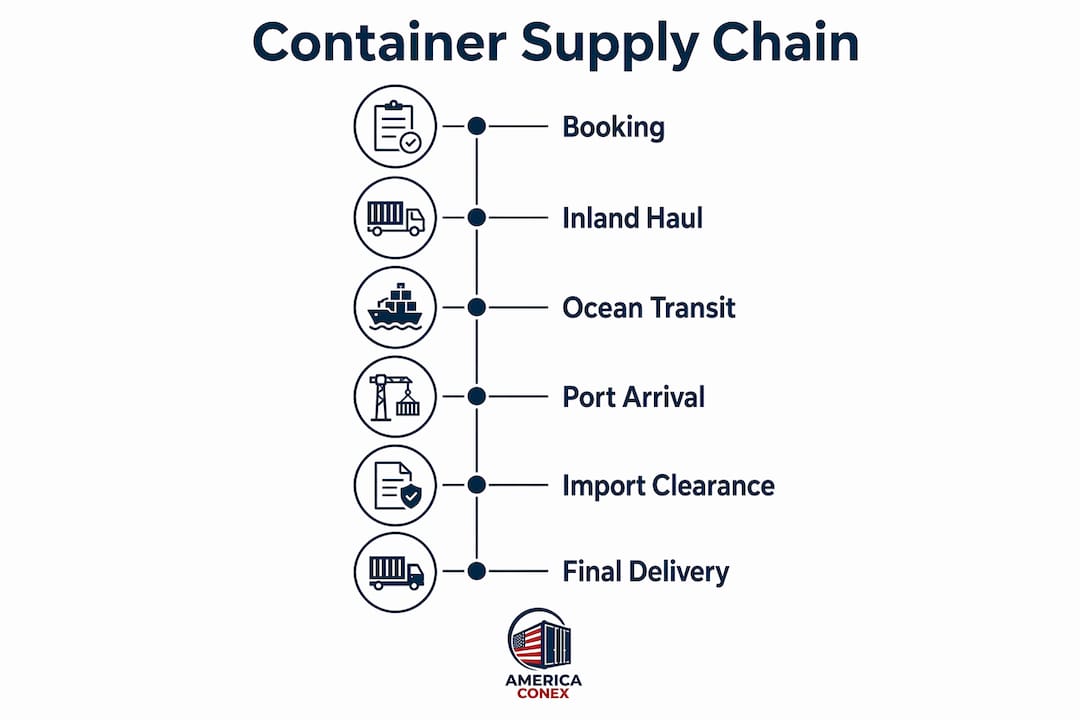
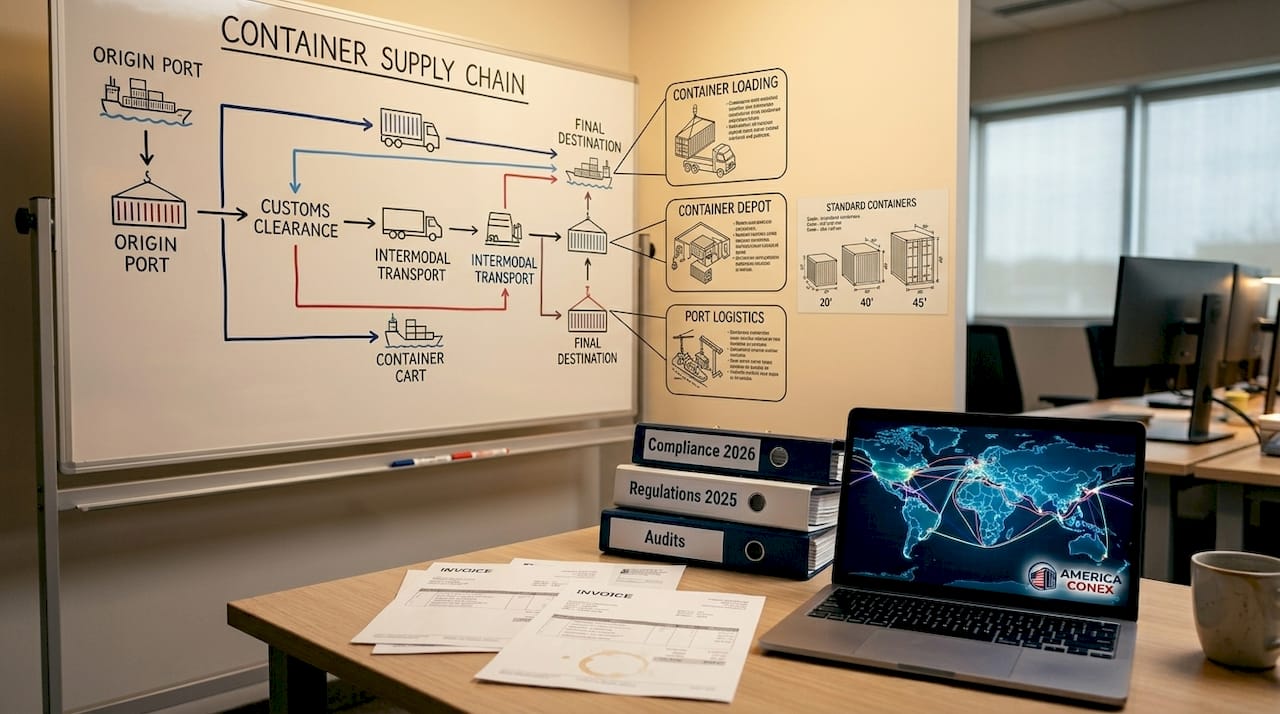
The container supply chain process runs along two parallel tracks: physical movement and documentation. Both must stay synchronized or the entire shipment stalls.
Booking and pre-shipment preparation
The process begins when a shipper books space with a carrier or freight forwarder. At this stage, the commercial invoice, packing list, and bill of lading instructions are prepared. The shipper also confirms whether the shipment moves as Full Container Load (FCL) or Less than Container Load (LCL), since that choice determines every downstream handling step. Digital manifests and smart ports now reduce dwell times significantly, which means documentation errors caught early have a measurable impact on total transit time.
Inland haul, export clearance, and ocean transit
Once cargo is packed and sealed, it moves by truck or rail to the origin container yard (CY). Export customs clearance runs concurrently, covering commodity classification, export licensing if required, and submission of the Electronic Export Information (EEI) through the Automated Export System (AES). After the container passes Container Security Initiative (CSI) inspection protocols at the terminal, it is loaded onto the vessel. Ocean transit introduces variability from weather, route congestion, and the growing influence of decarbonization rerouting as carriers adjust to IMO emissions targets.
Port arrival, import clearance, and final delivery
At the destination port, the container is unloaded, assigned a terminal yard slot, and held until import customs clearance is granted. Clearance is not the finish line. Terminal release messaging, gate-in sequencing, and truck appointment systems all create additional dependencies that can delay pickup by days even after customs approves the release. Once all holds are lifted, the container moves inland by drayage truck or intermodal rail to the final consignee.
The table below summarizes typical durations across critical path stages for a standard FCL shipment on a trans-Pacific lane.
| Stage | Typical Duration | Key Risk Factor |
|---|---|---|
| Booking to gate-in | 3 to 7 days | Documentation errors, space availability |
| Export clearance | 1 to 3 days | Commodity classification, licensing |
| Ocean transit (trans-Pacific) | 14 to 21 days | Weather, port congestion, rerouting |
| Port arrival to customs release | 2 to 5 days | Exam selection, document holds |
| Terminal release to delivery | 1 to 3 days | Gate sequencing, truck availability |
Pro Tip: Monitor gate-in sequencing and terminal release status as separate milestones in your tracking system. Customs clearance and physical container availability are not the same event, and conflating them is the single most common cause of missed delivery windows.
How do CY/CY, FCL, and LCL terms affect container shipping flow?
Contractual terms in container shipping are not just pricing labels. They define who is responsible for the container at each point in the journey, and they directly determine cost exposure and operational complexity.
CY/CY means container yard to container yard movement, where the carrier's responsibility begins when the container is received at the origin CY and ends when it is made available at the destination CY. Port/Port terms are narrower, covering only the port of loading to the port of discharge and excluding inland charges at either end. The practical difference is significant: a CY/CY contract gives the shipper more predictability on total cost, while Port/Port terms require the buyer or consignee to arrange and pay for inland moves independently.
FCL and LCL define how the container is loaded. FCL means one shipper fills the entire box, which simplifies handling, reduces cargo exposure, and speeds up terminal processing. LCL means multiple shippers share a container, which requires consolidation at a Container Freight Station (CFS) at origin and deconsolidation at a CFS at destination. LCL shipments extend total transit time by two to five days at the destination alone due to the additional handling stages involved. That delay matters when you are managing just-in-time inventory.
Liner terms and Free In/Free Out (FIO) clauses further shift cost responsibility for loading and unloading between the carrier and the cargo owner. Understanding these terms before signing a service contract prevents disputes over demurrage and detention charges later.
The table below compares the five main container types used in global trade.
| Container Type | Common Abbreviation | Typical Use | Cost Factor |
|---|---|---|---|
| General Purpose | GP | Dry cargo, manufactured goods | Baseline rate |
| High Cube | HC | Voluminous light cargo, e-commerce | Slight premium |
| Refrigerated | RE (Reefer) | Perishables, pharmaceuticals | Significant premium |
| Open Top | OT | Oversized or crane-loaded cargo | Moderate premium |
| Flat Rack | FR | Heavy machinery, vehicles | Higher premium |
Selecting the right container type at booking is a container size decision that affects both cost and cargo integrity throughout the entire journey.
What 2026 regulations are reshaping container supply chains?
Two regulatory changes effective in 2026 carry direct operational consequences for logistics managers handling containerized cargo.
SOLAS 2026 mandates immediate reporting of lost containers to nearby ships, the nearest coastal State, and the flag State. This requirement stems from IMO resolution MSC.550(108) and applies to all vessels carrying containers on international voyages. Non-compliance can result in port state control deficiencies and vessel detention, which cascades into missed port calls and supply chain disruption for every shipper on that vessel. The reporting obligation is not discretionary. It activates the moment a container is lost overboard.
On the customs side, CBP requires electronic manifest submission through the Automated Commercial Environment (ACE) system for ocean cargo arriving at U.S. Virgin Islands ports, effective March 7, 2026. This applies to foreign shipments, in-bond movements, and shipments originating from the U.S. mainland and Puerto Rico. The practical implication is that any carrier or freight forwarder without ACE integration for these routes faces immediate compliance exposure.
Key compliance actions for logistics managers in 2026:
- Confirm your carrier's SOLAS lost container reporting protocol is documented and tested before shipment.
- Verify that your freight forwarder has ACE filing capability for all U.S. territory routes, not just mainland ports.
- Build penalty risk into your contract review process for any lane touching U.S. Virgin Islands ports.
- Maintain a separate workflow playbook for disruption-driven policy-mode execution, since regulatory events change documentation rules, seal requirements, and storage permissions simultaneously.
Pro Tip: Integrate a digital compliance monitoring tool that flags regulatory updates by trade lane. Waiting for your forwarder to notify you of changes like the ACE mandate puts you in a reactive position. Proactive monitoring is the difference between a smooth filing and a vessel hold.
What operational bottlenecks most affect container logistics efficiency?
Operational delays in container logistics cluster around four recurring pressure points, each of which compounds the others when they occur simultaneously.
Depot and port congestion is the most visible bottleneck. Depot congestion and slower container rotation cause longer dwell times and container shortages, particularly for 40ft high cube and refrigerated units in Europe in 2026. When containers sit idle at depots, the entire rotation cycle slows, reducing equipment availability for exporters weeks later and thousands of miles away.
LCL deconsolidation complexity adds time and cost that many shippers underestimate. CFS performance depends more on geography and operational philosophy than on technology, which means two CFS facilities in the same port can deliver dramatically different outcomes for the same shipment. Choosing a freight forwarder with a strong CFS network is not a secondary consideration. It is a primary cost driver for LCL shippers.
Customs clearance misconceptions create avoidable delays. Treating a customs release as the signal that a container is ready for pickup ignores the terminal release messaging, document event sequencing, and truck gate-in appointment systems that must all align before the box moves. Effective schedule risk management must cover the full workflow, not just clearance status.
Payload underutilization is a cost problem disguised as an operational one. Optimizing container density can reduce landed costs by over 30% by reducing the number of equipment units and administrative touchpoints required per shipment. That is a structural saving, not a one-time discount. You can also review container cost factors to identify where payload and pricing decisions intersect.
Pro Tip: Build a container dwell time tracker by depot and terminal. Patterns in dwell data reveal which nodes in your network consistently underperform, giving you the evidence to renegotiate service agreements or reroute cargo before delays become chronic.
Key takeaways
The container supply chain requires synchronized physical movement and documentation workflows, with 2026 regulatory changes from SOLAS and CBP adding new compliance layers that logistics managers must address proactively.
| Point | Details |
|---|---|
| Parallel tracks drive timing | Physical movement and documentation must stay synchronized or shipments stall at any stage. |
| FCL vs. LCL determines complexity | LCL adds two to five days at destination due to CFS deconsolidation; FCL simplifies handling and speeds clearance. |
| SOLAS 2026 creates new liability | Lost container reporting is now mandatory under IMO MSC.550(108), with non-compliance risking vessel detention. |
| Customs clearance is not container ready | Terminal release, gate-in sequencing, and document events must all align before physical pickup is possible. |
| Payload optimization cuts landed costs | Maximizing container density reduces equipment units and can lower landed costs by over 30%. |
What I've learned after years of watching containers move
The single biggest misconception I see among logistics managers is treating the container supply chain as a linear checklist. It is not. It is a network of interdependent events where a delay at one node, say a CFS deconsolidation backlog in Los Angeles, can trigger a missed appointment at a distribution center in Chicago three days later. The checklist mindset makes you reactive. The network mindset makes you predictive.
The 2026 SOLAS reporting requirement is a good example of how regulatory change exposes operational gaps. Most managers I speak with know the rule exists. Far fewer have actually tested whether their carrier's reporting protocol works under pressure. A rule that exists on paper but fails in execution is worse than no rule at all, because it creates false confidence.
Digitalization is genuinely changing container flow visibility, but not uniformly. Smart port systems at major hubs like the Port of Rotterdam or the Port of Los Angeles deliver real-time gate event data. Smaller feeder ports often still rely on manual updates. If your supply chain runs through secondary ports, your visibility is only as good as the weakest node in that chain.
My strongest recommendation for 2026 is to build separate workflow playbooks for disruption scenarios. When a regulatory event, a weather disruption, or a vessel diversion hits, the standard operating procedure breaks down. The managers who recover fastest are the ones who already have a policy-mode playbook that covers documentation rule changes, seal requirements, and storage permissions as a single coordinated response, not a series of improvised calls.
— Alex
How Americaconex supports your container supply chain
Whether you are sourcing containers for secure job site storage, depot staging, or direct international shipping, Americaconex delivers the right unit to the right location without the delays that erode supply chain performance. With access to 30+ depots nationwide, Americaconex stocks used wind and water tight (WWT) containers, one-trip units in like-new condition, and cargo worthy containers in both 20ft and 40ft standard and high cube configurations. Review the full container quality grades to match the right specification to your operational requirements, and check container dimensions to confirm payload and volume fit before you commit. Americaconex offers transparent pricing and fast delivery across the U.S., so your container is an asset in your supply chain, not a variable.
FAQ
What is the container supply chain?
The container supply chain is the integrated sequence of transport, handling, documentation, and regulatory steps that moves shipping containers from origin suppliers to end recipients. It combines physical logistics with parallel documentation workflows managed by carriers, freight forwarders, customs authorities, and port terminals.
What is the difference between FCL and LCL shipping?
FCL (Full Container Load) means one shipper occupies the entire container, while LCL (Less than Container Load) means multiple shippers share a single container. LCL requires consolidation and deconsolidation at Container Freight Stations, which typically adds two to five days to destination transit time.
What does the SOLAS 2026 lost container rule require?
SOLAS 2026 requires vessels to immediately report lost containers to nearby ships, the nearest coastal State, and the flag State under IMO resolution MSC.550(108). Non-compliance can result in port state control deficiencies and vessel detention.
What is the CBP electronic manifest requirement for 2026?
CBP requires electronic submission of ocean cargo manifests through the ACE system for shipments arriving at U.S. Virgin Islands ports, effective March 7, 2026. This applies to foreign shipments, in-bond movements, and cargo originating from the U.S. mainland and Puerto Rico.
Why does customs clearance not mean a container is ready for pickup?
Customs clearance is one step in a multi-event sequence that also includes terminal release messaging, document event processing, and truck gate-in appointment scheduling. All of these steps must complete before a container can physically leave the terminal, and each carries its own timing risk.