
TL;DR:
- Standard containers meet ISO 668 specifications, enabling seamless global shipping and storage.
- 20ft and 40ft containers are most common, with high-cube versions offering extra headroom.
- Used WWT containers are cost-effective and suitable for storage, while new ones are ideal for shipping.
Over 90% of the world's manufactured goods travel inside a small set of standardized steel boxes. That single fact tells you how important it is to understand what a standard container actually is before you rent or buy one. Many people assume all shipping containers are interchangeable, but the wrong size or grade can cost you money, delay your shipment, or leave you with a storage unit that doesn't fit your site. This guide walks you through every key detail, from ISO dimensions and materials to condition grades and practical use cases, so you can make a confident, cost-effective decision.
Table of Contents
- What makes a container standard?
- Key sizes and measurements: 20ft vs 40ft containers
- Special variations and US-specific nuances
- Standard containers for storage and shipping: Choosing the right option
- Why standard containers remain the best choice for most US needs
- Find your perfect container solution with America Conex
- Frequently asked questions
Key Takeaways
| Point | Details |
|---|---|
| Standard sizes explained | The main standard containers are 20ft and 40ft long, often with a high-cube variation for extra volume. |
| Versatility for US uses | Standard containers are ideal for personal moves, business storage, and bulk shipping due to their size and strength. |
| Cost-effective solutions | Used containers, especially wind and water tight grades, offer affordable storage without sacrificing durability. |
| Edge cases matter | Special US sizes and container condition grades impact suitability and price for both shipping and storage. |
| Smart decision factors | Choosing based on size, grade, and use-case ensures you get the best value and application from your container. |
What makes a container standard?
A container earns the label "standard" by meeting the rules set out in ISO 668, the international specification that governs steel intermodal containers. ISO 668 defines the exact external dimensions, corner casting positions, and structural strength requirements that allow a container to move seamlessly between ships, trains, and trucks anywhere in the world. Without that shared spec, every port crane, rail car, and flatbed truck would need a custom setup for every box. Standardization is what makes global trade fast and affordable.
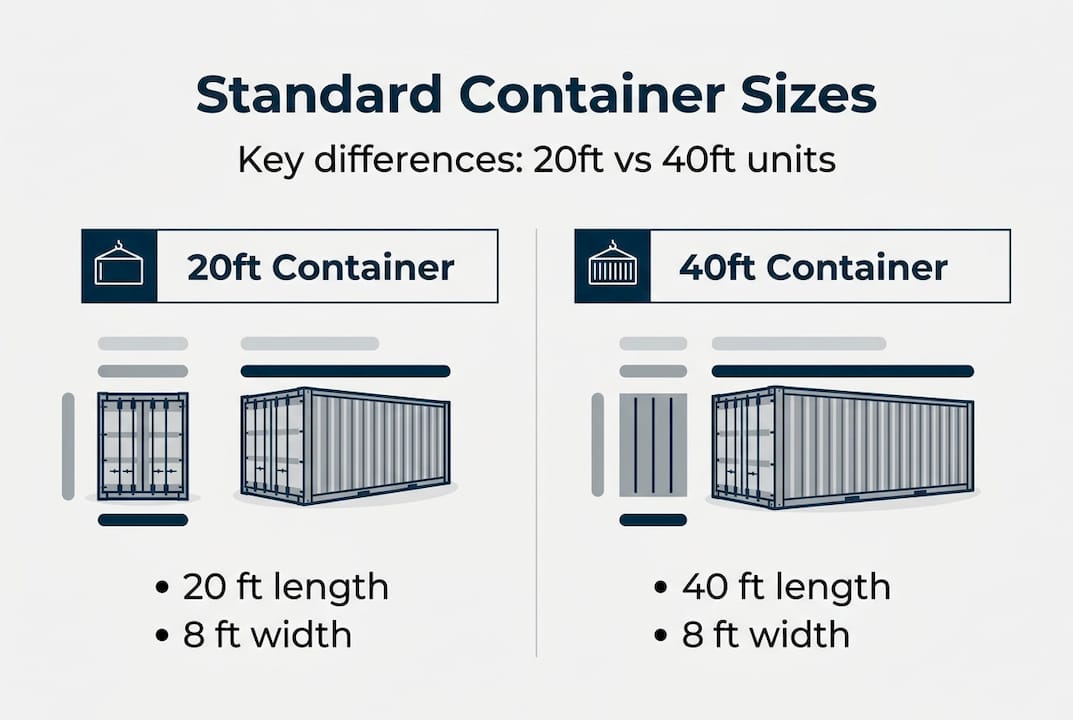
The two dominant lengths are 20 feet and 40 feet. Both are 8 feet wide, with a standard height of 8 ft 6 in or a high-cube height of 9 ft 6 in. The extra foot of headroom in a high-cube unit adds roughly 344 cubic feet of usable space, which matters a lot when you're storing tall equipment or bulky goods.
The material is equally important. Standard containers are built from Cor-Ten steel, a weathering alloy that forms a stable rust layer on its surface, protecting the metal underneath from deeper corrosion. That's why a well-maintained container can last 25 years or more in harsh outdoor conditions. You can brush up on more shipping container terms if some of this vocabulary is new to you.
Here's a quick overview of standard container specs:
- Length: 20 ft or 40 ft
- Width: 8 ft (external)
- Standard height: 8 ft 6 in
- High-cube height: 9 ft 6 in
- Material: Cor-Ten weathering steel
- Corner castings: ISO-spec twist-lock fittings
| Feature | Standard height | High-cube |
|---|---|---|
| External height | 8 ft 6 in | 9 ft 6 in |
| Internal height | ~7 ft 10 in | ~8 ft 10 in |
| Best for | General cargo, storage | Tall goods, light bulk cargo |
| Price premium | Baseline | Slightly higher |
Pro Tip: If you plan to walk inside your container regularly, a high-cube gives you comfortable headroom. Standard-height units can feel cramped for anyone over 5 ft 10 in.
You can also review container size standards from major freight carriers to see how these specs translate into real-world shipping decisions.
Key sizes and measurements: 20ft vs 40ft containers
Once you understand what makes a container standard, the next question is simple: which size do you actually need? The answer depends on volume, weight, and how you plan to use the box.
External dimensions at a glance:
| Spec | 20ft container | 40ft container |
|---|---|---|
| External length | 20 ft | 40 ft |
| External width | 8 ft | 8 ft |
| Internal length | ~19 ft 4 in | ~39 ft 5 in |
| Internal width | ~7 ft 8 in | ~7 ft 8 in |
| Internal height (std) | ~7 ft 10 in | ~7 ft 10 in |
| Volume (std) | ~1,172 cu ft | ~2,390 cu ft |
| Payload capacity | ~55,000 lbs | ~59,000 lbs |
One of the most practical metrics is pallet count. A 20ft container fits 10 to 11 standard pallets, while a 40ft container holds 20 to 25. That difference is significant for small businesses managing inventory or individuals planning a household move.
Here's how the two sizes map to real use cases:
- 20ft container: Personal moves, small business inventory, job site tool storage, single-room household goods
- 40ft container: Commercial bulk shipments, full household moves, retail stock, construction equipment
- 40ft high-cube: Oversized furniture, lightweight bulk goods, e-commerce fulfillment staging
Weight capacity is another factor people often overlook. While a 40ft unit carries slightly more than a 20ft unit in raw payload, US rail transport limits are considerably lower, around 24 metric tons for a 20ft and 30.5 metric tons for a 40ft. If your load is heading by rail, you need to plan for those lower limits, not the container's theoretical maximum.

For businesses thinking about how containers fit into a larger storage workflow efficiency plan, the 40ft unit often wins on a cost-per-cubic-foot basis. You typically pay less per square foot of storage space with a 40ft than with two 20ft units.
Statistic to keep in mind: A standard 40ft container holds roughly twice the volume of a 20ft unit but usually costs only 20 to 30% more to purchase. That math makes the 40ft a strong value for anyone with flexible space.
Special variations and US-specific nuances
The ISO standard covers the containers you'll encounter in international shipping, but the US market has its own wrinkles worth knowing about.
Domestic-only sizes are the biggest surprise for first-time buyers. The US uses non-ISO containers measuring 45 ft, 48 ft, and 53 ft for domestic rail and truck transport. These boxes are wider and taller than ISO units, which means they can't be loaded onto international vessels. If you're buying a container for domestic storage or ground transport only, a 53ft unit might seem appealing. But resale value is lower, and your options for repurposing it internationally are zero.
Here's a breakdown of common US container variations:
- 45ft ISO container: Slightly longer than standard, used in some international routes
- 48ft domestic: US truck and rail only, wider body
- 53ft domestic: Most common in US trucking, not ISO-compliant
- High-cube (20ft or 40ft): Extra foot of height, ISO-compliant, widely available
Condition grades are equally important when you're buying used. The three grades you'll encounter most often are:
- IICL (Institute of International Container Lessors): Near-new condition, suitable for international cargo
- Cargo worthy (CW): Structurally sound, certified for international shipping
- Wind and water tight (WWT): Weatherproof but not certified for shipping; ideal for storage
A WWT container is the most cost-effective choice for on-site storage. It keeps your goods dry and secure without the price premium of a cargo-worthy unit.
Pro Tip: If you only need storage and won't be shipping the container internationally, a WWT unit saves you real money. You can explore secure storage solutions that use these grades effectively. For more ways to cut costs, check out this guide on saving on container costs.
Standard containers for storage and shipping: Choosing the right option
Now that you know the sizes, variations, and grades, the practical question is: how do you pick the right container for your specific situation?
Standard containers work well across a wide range of applications because intermodal standardization allows them to move by ship, rail, and truck without any modifications. That flexibility is the core reason they dominate global logistics and on-site storage alike. Used containers, in particular, offer strong value for non-shipping applications because they've already absorbed the initial depreciation.
Step-by-step decision process:
- Define your use case. Are you shipping internationally, storing on-site, or moving household goods? Each use case has a different grade requirement.
- Estimate your volume. Use the pallet count or cubic footage benchmarks from the table above to choose between 20ft and 40ft.
- Check your site. Measure your delivery area. A 40ft container needs roughly 50 ft of clear approach for a tilt-bed truck.
- Set your budget. Used WWT containers are the most affordable entry point. One-trip (like-new) units cost more but offer near-new condition.
- Verify delivery logistics. Confirm the supplier has a depot near you to keep freight costs low.
Key factors to weigh when evaluating options:
- Condition grade relative to your intended use
- Size based on volume needs, not just price
- Delivery distance from the nearest depot
- Resale or reuse potential if your needs change
For a deeper look at the financial side, the rent vs buy containers comparison is worth reading before you commit. Buying almost always wins for long-term storage, but short-term projects may favor a rental.
Quick stat: Used containers typically cost 40 to 60% less than one-trip units, making them the go-to choice for budget-conscious buyers who don't need certification for active shipping.
Why standard containers remain the best choice for most US needs
Here's something the container industry doesn't always say clearly: ISO dry van containers make up roughly 90% of the global fleet. That dominance isn't an accident. It reflects decades of real-world testing across every climate, port, and supply chain on earth.
We see buyers occasionally chase specialized containers, refrigerated units, open-top boxes, flat racks, and domestic 53ft units, thinking they're getting something better suited to their needs. Sometimes they are. But more often, the specialized unit costs more, has a smaller resale market, and creates logistical headaches when it's time to move or sell.
Standard 20ft and 40ft ISO containers are the most liquid asset in the container market. Parts are interchangeable, transport options are abundant, and buyers are easy to find if you ever want to sell. For the vast majority of US buyers, whether you're storing tools on a job site or shipping goods overseas, a standard ISO container is the reliable, cost-effective, and practical choice. Specialized types have their place, but they come with tradeoffs most buyers don't fully price in upfront. If you're weighing container alternatives, go in with clear eyes about those tradeoffs.
Find your perfect container solution with America Conex
If this guide helped you get clear on sizes, grades, and use cases, the next step is finding the right unit at the right price.
At America Conex, we supply new and used shipping containers for sale across the United States, with 30+ depots strategically placed for fast, affordable delivery to your location. Whether you need a budget-friendly WWT unit for on-site storage, a one-trip container in like-new condition, or a standard 20ft or 40ft unit for active shipping, we have options ready to go. Our team is here to help you match the right container to your exact needs, without the guesswork. Reach out today for a transparent, no-pressure quote.
Frequently asked questions
What are the main standard container sizes?
The most common standard sizes are 20ft and 40ft long, both 8ft wide. Heights are typically 8ft 6in for standard units and 9ft 6in for high-cube units.
Can I use a standard container for residential storage?
Yes. Standard containers are built from Cor-Ten weathering steel, making them highly durable and weather-resistant for long-term home storage on any property.
What is the weight capacity of a standard 20ft or 40ft container?
A 20ft container carries up to approximately 55,000 lbs, and a 40ft container carries about 59,000 lbs. US rail transport limits are lower, so check those if your shipment travels by train.
Do high-cube containers offer more value?
High-cube units add 1ft of height and roughly 30% more volume, making them cost-effective for tall or light cargo where standard headroom would be a limiting factor.
Are used containers safe for storage purposes?
Used containers graded WWT (Wind and Water Tight) are safe, weatherproof, and cost-effective for storage. They are not certified for active international shipping, but they perform well for on-site use.