
TL;DR:
- Container stacking involves both load-bearing safety standards and efficient storage placement strategies to prevent costly reshuffles. Proper planning requires understanding physical loading rules, safety regulations, and operational logistics to optimize yard efficiency and safety. Implementing integrated, rule-based stacking practices and using reliable containers from providers like America Conex can maximize storage space and safety in any facility.
Container stacking is one of those concepts that sounds straightforward until you actually try to do it at scale. Most people assume it just means piling containers on top of each other. In reality, what is container stacking covers two very different problems at once: the physical engineering of how containers bear load safely, and the operational logic of where containers should go in a yard so they can be retrieved without wasting time or money. Get either one wrong, and you're looking at safety risks, expensive reshuffling, or both. This guide breaks down both sides so you can plan smarter.
Table of Contents
- The basics of container stacking: physical and operational perspectives
- Container stacking strategies that improve yard efficiency and sustainability
- Safety considerations and standards for physically stacking shipping containers
- Common challenges in container stacking operations and expert solutions
- Best practices for businesses using container stacking to optimize storage spaces
- Why container stacking is both an engineering and a strategic challenge, not just a logistics afterthought
- Optimize your container stacking with America Conex solutions
- Frequently asked questions
Key Takeaways
| Point | Details |
|---|---|
| Container stacking dual nature | Container stacking combines both physical stacking hardware and operational yard placement strategies for efficiency and safety. |
| Stacking strategy impacts efficiency | Choosing the right stacking approach reduces reshuffling and energy use, improving yard productivity. |
| Safety depends on corner posts and locks | Proper alignment and use of corner castings and twist locks ensure stable, safe container stacks. |
| Operational and structural planning | Integrating operational scheduling with physical stacking constraints prevents handling inefficiency and risks. |
| Practical site preparation | Level ground and adherence to OSHA guidelines are critical foundations for safe container stacking. |
The basics of container stacking: physical and operational perspectives
Container stacking is not a single discipline. It's two separate but tightly connected challenges that often get confused with each other, creating real problems in the field.
On the physical side, stacking is about how ISO-standard shipping containers transfer load through their structure. ISO corner posts and castings bear the vertical loads in a stack, not the container walls or roof. This is a critical distinction. If containers are misaligned even slightly, the load shifts off the corner posts and onto structural members that are not designed to carry it. The result can be a stack failure that damages cargo or, worse, injures workers.
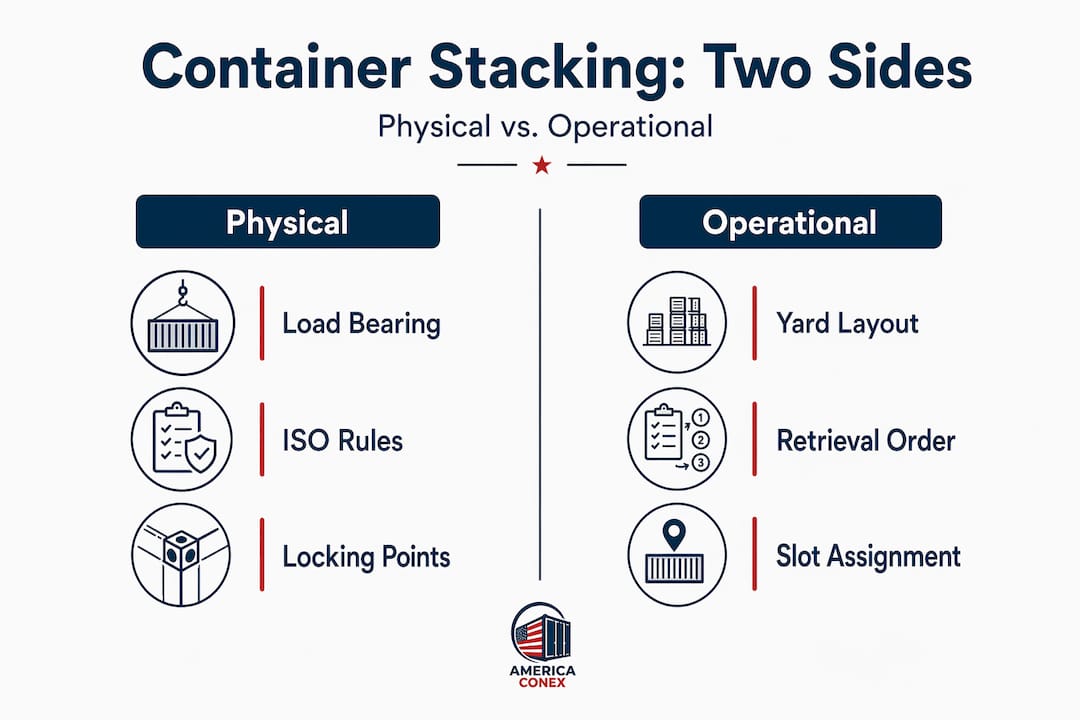
On the operational side, container stacking means assigning storage locations in a terminal or yard for efficient retrieval. In other words, it's a slot assignment problem: where do you put container A so that when it's needed, you don't have to move containers B, C, and D first?
These two meanings often collide in practice. Yard planners focused purely on slot optimization sometimes ignore the physical weight and alignment rules. Equipment operators focused on physical placement sometimes stack containers in a sequence that buries the next outbound load. Both mistakes cost money.
Here's what the physical stacking rules mean at a practical level:
- Corner castings at the top and bottom of each container must align precisely when stacking
- Twist locks are used to connect stacked containers at the corners, preventing lateral movement
- Load bearing runs vertically through corner posts, which is why damaged corner posts are a red flag before stacking
- Ground-level containers carry the full cumulative weight of every container above them
- Uneven or soft ground creates uneven stress on corner posts and can compromise an entire stack
To master container storage best practices, you need to understand both sides of this equation before you make your first placement decision.
Container stacking strategies that improve yard efficiency and sustainability
With a clear understanding of what container stacking entails, we can look at how different placement strategies affect yard efficiency and even energy consumption. This is where logistics meets data science.
Two primary stacking strategies dominate container yard operations:
-
FIFO (first-in, first-out): Containers that arrive first are stacked in positions that give them priority access when it's time to leave. Under high-load yard conditions, FIFO stacking achieves the lowest reshuffling intensity and energy consumption. When a yard is packed, getting the right container out without disturbing others becomes the dominant concern, and FIFO addresses that directly.
-
Departure-time clustering: Containers headed out in the same time window get grouped together in the same stack or bay. This reduces crane moves during the outbound rush, which matters most when a yard is clearing large batches at scheduled times such as vessel departures.
-
Bay-level segregation: Containers with similar characteristics (weight class, destination, hazard rating) are segregated at the bay level during storage assignment. This prevents a heavy container from being placed above a lighter one, which would require a physical reshuffle before the lighter one could leave.
-
Algorithm-assisted placement: Advanced optimization approaches like NSGA-II (a multi-objective evolutionary algorithm) find stacking plans that trade off multiple competing goals at once. Instead of just minimizing reshuffles, these tools balance crane energy use, yard crane path length, and retrieval time simultaneously.
One insight that surprises most logistics newcomers: minimizing crane moves does not automatically minimize energy consumption. Fewer long crane cycles can use more energy than more short ones, depending on equipment. That's why a well-designed shipping container storage workflow treats energy and operations as separate but connected targets.
"The choice of stacking strategy must account for real-time yard conditions, not just static slot assignments, because dynamic yard loads change which strategy performs best at any given hour."
Safety considerations and standards for physically stacking shipping containers
Now that stacking strategies are clear, the physical safety rules deserve their own focused treatment. These are not suggestions. Several of them are codified in ISO standards and OSHA regulations.
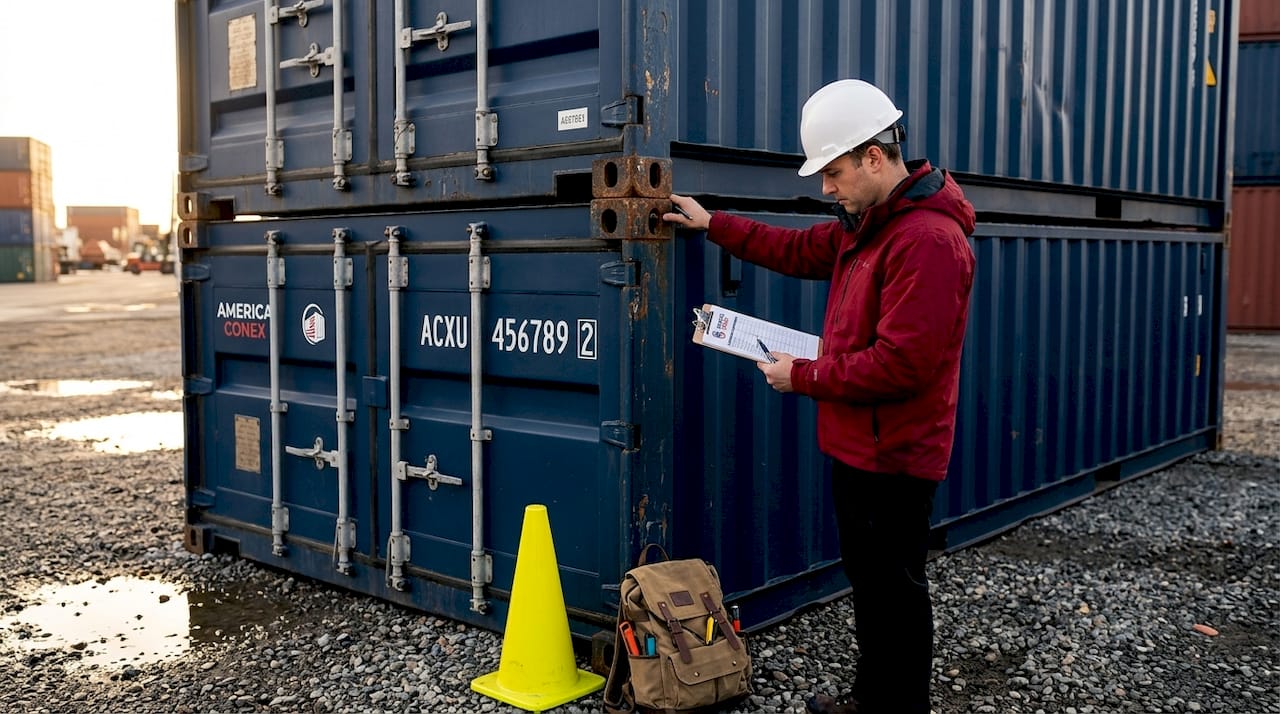
Weight limits: ISO 1496-1 sets the stacking weight limit at 192,000 kg for a standard container, revised up to 213,360 kg in the 2005 update. That figure accounts for dynamic acceleration factors used in ship transport. On land, actual limits depend on the container's condition and your ground preparation.
OSHA requirements: OSHA mandates that stacked materials be blocked, interlocked, and limited in height to maintain stability and protect workers. For shipping containers, this means twist locks are not optional above one container high, and stack height must be capped based on site conditions and equipment ratings.
Key physical safety rules to follow on any stacking project:
- Confirm corner castings are undamaged before stacking. Deformed castings under load can cause sudden stack collapse
- Use certified twist locks rated for the container weight you're stacking. Not all twist locks are equal
- Two loaded containers high is the practical safe limit for most construction and storage sites without specialized lifting equipment
- Three high is possible with proper equipment and perfectly level ground, but requires engineering sign-off in most commercial settings
- Never stack a heavier container above a lighter one. The weight ratio affects corner post stress across the entire stack
- Inspect the ground or pad beneath the base container. Soft ground causes differential settling that tilts corner post loads dangerously
Pro Tip: When stacking above one container high, have a second person confirm that each twist lock has fully engaged before the lift equipment moves away. A partially engaged lock looks the same as a fully engaged one from a distance and will fail under lateral wind or crane load.
For a deeper look at placement rules, check out the storage best practices guide to plan your site setup correctly from the start.
Common challenges in container stacking operations and expert solutions
Having covered physical safety, the operational headaches deserve direct attention. Container stacking creates a specific class of problem: what happens when you need a container that's buried under three others?
This is called overturning or reshuffling, and containers stacked above the target require repositioning, creating costly and time-consuming moves that ripple through yard schedules. In a busy port, a single badly placed container can delay multiple trucks and tie up a yard crane for an hour.
The main operational challenges and proven responses:
- Blocking: A needed container is buried under others that are not due to depart. Solution: departure-time clustering during initial placement prevents most blocking scenarios before they happen
- Crane path inefficiency: Yard cranes zigzagging between non-adjacent stacks waste time and energy. Solution: zone-based stacking keeps related containers in the same crane operating corridor
- Truck and crane timing mismatches: Trucks arriving before cranes are ready, or cranes idle while trucks queue, create congestion. Solution: collaborative scheduling coordinates truck arrival windows with crane availability in real time
- Unplanned container weight changes: Cargo added or removed at the last minute changes a container's weight class after it has already been placed. Solution: flag weight class changes immediately and trigger a proactive re-slot before the retrieval window opens
| Challenge | Impact | Primary solution |
|---|---|---|
| Blocking (buried target) | Added crane moves, delay | Departure-time clustering |
| Crane path inefficiency | Energy waste, lower throughput | Zone-based slot assignment |
| Truck-crane timing mismatch | Congestion, idle equipment | Collaborative scheduling |
| Weight class changes post-placement | Safety risk, reshuffle | Real-time weight flag and re-slot |
Pro Tip: When planning a container yard, assign stacking groups by retrieval sequence before the first container arrives. Reactive re-slotting after containers are in place costs three to five times more in crane moves than proactive grouping at the intake stage.
Tying your placement rules to a clear container storage workflow makes this kind of proactive planning much easier to execute consistently.
Best practices for businesses using container stacking to optimize storage spaces
Theory becomes real money when you apply it on your own site. Whether you're managing a construction yard with four containers or coordinating a regional depot with forty, the same core principles govern whether your stack works well or costs you extra time every week.
Stacking containers properly can multiply usable storage footprint without expanding your site area. That means the return on doing it right is not just safety. It's also floor space, which is expensive in most U.S. urban and industrial markets.
Follow these steps to set up a safe, efficient container stack from day one:
- Prepare a level, compacted foundation. Concrete pads or compacted gravel are the two most reliable surfaces. Soft dirt or asphalt in summer heat can allow differential settling that tilts corner posts.
- Confirm your equipment rating before going above one high. Your forklift or crane must be rated for the combined weight of all containers it will lift and position. Never improvise with undersized equipment.
- Install twist locks on every stack above one container. Inspect locks before and after each placement.
- Choose your stacking strategy before containers arrive. For a small site, FIFO is the simplest and most effective. For larger sites with scheduled departures, departure-time clustering pays off faster.
- Label containers and maintain a stack map. A simple spreadsheet or whiteboard diagram showing which container is in which position saves hours of wasted searching and prevents unnecessary crane moves.
| Scenario | Recommended max height | Strategy | Key equipment |
|---|---|---|---|
| Construction site storage | 2 high | FIFO | Twist locks, level pad |
| Regional depot, high volume | 3 high with engineering sign-off | Departure-time clustering | Certified twist locks, RTG crane |
| Personal or farm storage | 2 high | Single-stack preferred | Twist locks, compacted gravel |
| Port container yard | 4-5 high | Algorithm-assisted | Reach stacker, RTGC |
Pro Tip: Before ordering containers for a stacking project, check the container grades available to you. A cargo-worthy container has structurally verified corner posts, which is the single most important factor in safe physical stacking.
For a full walkthrough of how to convert containers for storage in a stacked configuration, including shelving, ventilation, and access planning, it's worth reviewing your layout options before your first delivery drops.
Why container stacking is both an engineering and a strategic challenge, not just a logistics afterthought
Here's what most container guides miss entirely: container stacking is two problems wearing the same name. And conflating them is one of the most expensive mistakes operators make.
Confusing container slot assignment logic with physical stacking constraints leads to poor planning and extra handling. We see this play out in real yards when a logistics software tool assigns a container to the most algorithmically efficient slot, but that slot requires placing a 20-ton loaded container above a lighter one that's due out first. The algorithm was right on its own terms. But it violated both a physical safety rule and a retrieval sequence rule simultaneously.
The engineers who designed ISO container stacking standards were solving a load-bearing problem aboard ships at sea. The logistics planners who designed yard assignment algorithms were solving a scheduling problem on flat ground. Neither group was solving the other's problem. When you run a real container yard, both problems land on the same piece of ground at the same time.
The fix is not complicated, but it is deliberate. Physical stacking rules need to be hard constraints inside any yard planning system, not optional filters. Weight class, corner casting condition, and maximum stack height for your equipment must be inputs that the planning system cannot override in pursuit of efficiency gains. Operational goals like FIFO or departure clustering then operate within those physical boundaries.
This integrated view is often skipped in smaller operations because it feels like overkill. It isn't. A two-container stack on a construction site has the same physics as a five-container stack in a major port. The consequences are just smaller. Treat it like engineering from day one, and your container storage best practices will hold up whether you're managing four containers or four hundred.
Optimize your container stacking with America Conex solutions
Putting these principles into practice starts with having the right containers. Structurally sound corner posts, verified cargo-worthiness, and consistent dimensions are not just nice to have; they are the foundation of any safe stacking plan.
America Conex supplies new and used shipping containers across the United States, with access to 30+ depots for fast, reliable delivery wherever your site is located. Whether you need cargo-worthy containers for verified stacking strength, or you want to review exact container dimensions to plan your site layout before delivery, we have the information and inventory to support your project. Browse our full range of shipping containers for sale and get expert guidance from a team that understands both the physical and operational sides of container stacking.
Frequently asked questions
What exactly does container stacking mean in shipping and storage?
Container stacking covers both the physical placement of containers on top of each other following ISO load-bearing rules and the strategic assignment of storage locations in a yard for efficient retrieval. Treating them as the same thing is a common and costly mistake.
How many containers can safely be stacked on a typical shipping container?
A bottom 40-foot container can support up to 6 containers stacked above it under ISO standards, for a total of 7 high, but on most job sites and storage yards, stacks are limited to two or three high based on equipment capability and safety requirements.
Why is container stacking strategy important in yard operations?
The right stacking strategy directly controls how many extra crane moves you need to retrieve any given container. Stacking strategies significantly affect reshuffling intensity and energy consumption, meaning a poor strategy can double your handling costs without adding a single container to your yard.
What safety equipment is essential for stacking containers securely?
Twist locks are the non-negotiable piece of equipment for any stack above one container high. Twist locks connect containers mechanically by engaging the corner castings, which prevents both lateral sliding and lifting separation that can cause a stack collapse under wind load or crane contact.