

TL;DR:
- Site conditions and access strongly influence the most suitable container transport method.
- Tilt-bed trucks are ideal for local, level ground deliveries without additional equipment.
- Intermodal rail-truck combines cost savings and efficiency for long-distance container moves over 750 miles.
Choosing the wrong container transport method can quietly double your costs before the truck even backs out of your driveway. Whether you're moving a 20ft storage unit to a job site or shipping a 40ft container across the country, the logistics details most people skip, like site clearance, ground conditions, and unloading equipment, are exactly what turn a $500 delivery into a $1,500 headache. This guide breaks down every major transport option, compares real costs, and gives you a clear framework for making the right call the first time.
Table of Contents
- Key criteria for choosing a container transport method
- Tilt-bed truck delivery: Fast and equipment-free
- Flatbed truck with crane/forklift: Versatile for bulk and urban needs
- Intermodal truck-rail: Best for long-distance and bulk moves
- Which container transport option fits your situation?
- Why most container transport decisions are upside down
- Ready to book secure, affordable container transport?
- Frequently asked questions
Key Takeaways
| Point | Details |
|---|---|
| Site conditions matter | Always check ground clearance and access before booking container delivery. |
| Tilt-bed delivers simplicity | Tilt-bed trucks are ideal for short moves and easy placement without lifting equipment. |
| Flatbed suits urban jobs | Flatbed plus crane is versatile for bulk, urban, or precise delivery, but may cost more overall. |
| Intermodal saves big on distance | Truck-rail transport cuts costs up to 40% for bulk moves over 750 miles. |
| Prep and timing cut costs | Site preparation and off-peak booking help avoid unnecessary fees and delivery delays. |
Key criteria for choosing a container transport method
Before you book anything, you need to understand what actually determines which transport method works for your situation. Price is only one piece of the puzzle. The wrong method for your site conditions can result in a failed delivery, a rescheduling fee, and sometimes even damage to your property.
Here are the core factors to evaluate:
- Site clearance and access: Tilt-bed needs 100-120ft of straight, level clearance; flatbed requires a crane or forklift on site. Tight driveways, overhead wires, and soft ground all affect which truck can physically complete the job.
- Ground conditions: Mud, gravel, or uneven terrain can prevent a tilt-bed from sliding a container off safely. Wet ground is a common reason deliveries fail on the first attempt.
- Container weight and intended use: A fully loaded cargo worthy container behaves differently in transport than an empty storage unit. Weight affects which truck class and unloading method you need.
- Available unloading equipment: If you don't have a forklift or crane on site, tilt-bed is often your only practical option for residential or small business deliveries.
- Distance and route complexity: Local moves under 50 miles favor tilt-bed. Cross-country moves over 750 miles almost always benefit from intermodal truck-rail combinations.
- Budget sensitivity: Every failed delivery attempt costs money. Factor in re-delivery fees, crane standby charges, and site prep costs before you commit to the cheapest quote.
For site accessibility advice specific to your setup, it pays to consult with your provider before booking.
Pro Tip: Always measure your site clearance and check for overhead obstructions before calling a transport company. A five-minute site walk can save you hundreds in failed delivery fees.
With the criteria clear, let's explore each major transport option in detail.
Tilt-bed truck delivery: Fast and equipment-free
Tilt-bed delivery is the most common method for moving containers to homes, farms, and small business sites. The truck tilts its bed at an angle and slides the container off using gravity and a winch system. No crane. No forklift. No extra equipment needed on your end.
For most individuals and small businesses, this is the default choice because it's simple and fast. Tilt-bed delivery costs $300-$800 for local moves under 50 miles, rising to $400-$1,200 for a 20ft container depending on distance and terrain. That price typically includes placement, which is a real advantage over flatbed options.
"Tilt-bed trucks are the workhorses of container delivery for storage and construction moves. They eliminate the need for unloading equipment entirely, but site conditions have to be right or the whole operation stalls." This is exactly why site prep matters as much as price shopping.
Tilt-bed delivery is ideal for storage and construction moves where no unloading equipment is available on site.
Pros of tilt-bed delivery:
- No crane or forklift required
- Fast setup and placement
- Lower total cost for one-off local moves
- Works well for residential and farm deliveries
Cons of tilt-bed delivery:
- Requires 100 or more feet of straight, level clearance
- Struggles on slopes, soft ground, or muddy surfaces
- Limited placement precision compared to crane-assisted methods
- Not suitable for stacking containers
Where tilt-bed fails: If your site has a slope greater than about 5 degrees, a narrow driveway, or soft soil, the driver may not be able to complete the delivery safely. These edge cases are more common than people expect, especially on rural properties and active construction sites. Reviewing container workflow strategies ahead of time can help you plan your site layout to avoid these problems.
Tilt-bed delivery is popular. Now, see how flatbed and crane options compare.
Flatbed truck with crane/forklift: Versatile for bulk and urban needs
Flatbed transport separates the hauling from the unloading. The container rides on a standard flatbed trailer, and when it arrives, a crane or forklift places it exactly where you need it. This method costs less per mile, typically $200-$600 for local moves, but you need to budget $300-$1,000 for crane or forklift rental on top of that. Hooklift systems are safer and better suited for lighter loads, while cable roll-offs handle heavier and demolition-grade containers.
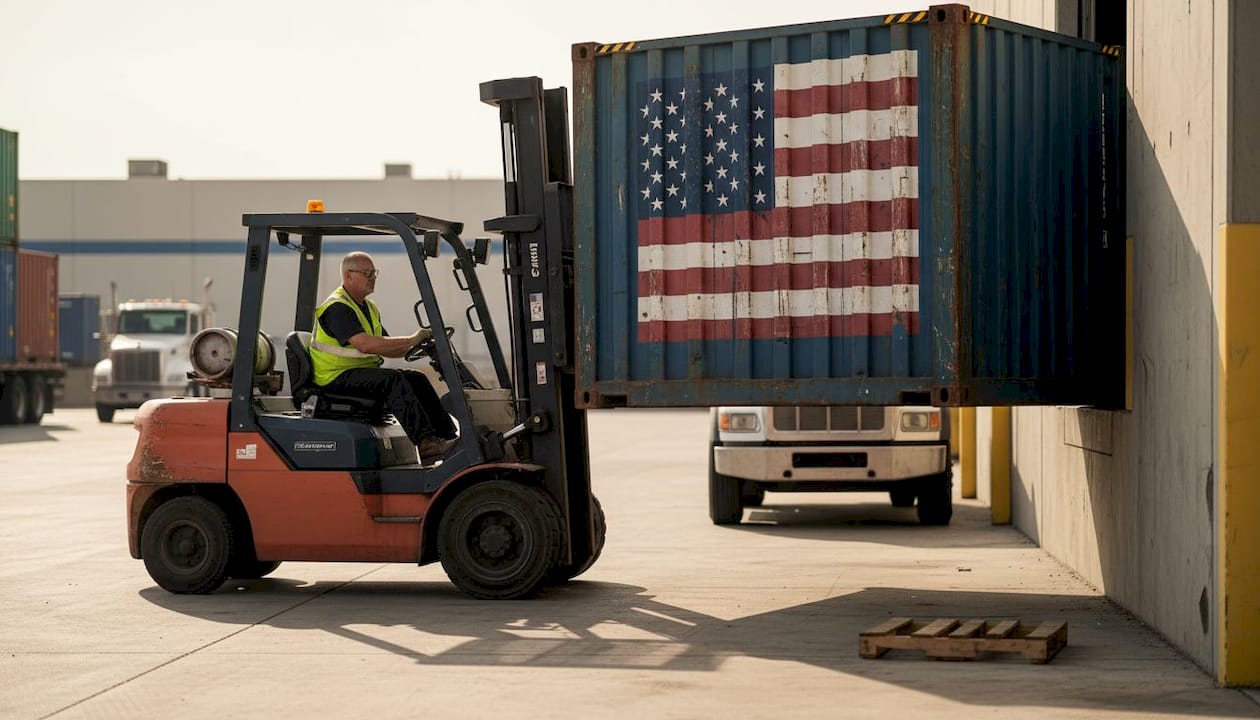
For urban deliveries, tight commercial lots, or any situation where precise placement matters, flatbed plus crane is the better tool. You can set a container on a rooftop, a second-floor platform, or within inches of a wall. That level of control is simply not possible with tilt-bed.
Here's how a typical flatbed plus crane delivery works:
- The flatbed truck delivers the container to your location.
- A separate crane truck or on-site forklift is positioned near the drop zone.
- The crane lifts the container off the flatbed using spreader bars attached to the corner castings.
- The container is lowered precisely onto your prepared surface or foundation.
- The crane operator confirms the container is level and stable before releasing.
Pro Tip: When requesting flatbed delivery, ask your provider whether they use hooklift or cable roll-off systems. Hooklift is generally safer for standard containers, while cable systems are better for heavier or irregular loads. Knowing the industry terms explained before you call will help you ask the right questions and avoid being upsold on equipment you don't need.
Flatbed is also the right call when you're moving multiple containers from a container depot to a single site, since you can consolidate loads and reduce per-unit transport costs.
For long-haul or cross-country moves, consider intermodal transport.
Intermodal truck-rail: Best for long-distance and bulk moves
Intermodal transport combines truck and rail to move containers over long distances at a fraction of the cost of trucking alone. The container is loaded onto a truck, driven to a rail terminal, transferred to a flatcar, and then picked up by another truck at the destination terminal. It sounds like more steps, but the economics are compelling.
Rail freight runs at 2-4 cents per ton-mile compared to 8-20 cents per ton-mile for trucking. For moves over 1,000 miles, intermodal saves 20-40% over trucking alone. That's not a rounding error. On a cross-country move, that difference can be thousands of dollars.
| Distance | Trucking only (est.) | Intermodal (est.) | Savings |
|---|---|---|---|
| Under 500 miles | $800-$2,000 | Not practical | N/A |
| 500-750 miles | $1,500-$3,500 | $1,200-$2,800 | 10-20% |
| 750-1,500 miles | $3,000-$6,000 | $1,800-$4,000 | 25-35% |
| 1,500+ miles | $5,000-$10,000+ | $3,000-$6,500 | 30-40% |
Intermodal is the right choice when:
- You're moving containers more than 750 miles
- You're shipping multiple containers and want to consolidate costs
- Timing is flexible and you can absorb a slightly longer transit window
- You want to reduce fuel and environmental costs on bulk logistics moves
The main trade-off is transit time. Rail is slower than direct trucking, and scheduling depends on terminal availability. For time-sensitive moves, trucking still wins. But for cost-saving on container logistics, intermodal is hard to beat at distance. If you're shipping a cargo worthy container for active freight use, intermodal is often the industry standard.
Let's look at the options head-to-head in a summary comparison table.
Which container transport option fits your situation?
| Method | Typical cost | Best for | Site requirements | Equipment needed |
|---|---|---|---|---|
| Tilt-bed | $300-$1,200 | Local, residential, no equipment | 100-120ft clearance, level ground | None |
| Flatbed + crane | $500-$1,600 | Urban, precise placement, bulk | Crane access, firm surface | Crane or forklift |
| Intermodal | $1,800-$6,500+ | Long-haul, 750+ miles, bulk | Terminal access required | None on-site |
Choose based on your actual situation:
- Storage or farm delivery: Tilt-bed is almost always the right call if your site has the clearance.
- Construction site or urban placement: Flatbed plus crane gives you precision and flexibility.
- Cross-country or multi-container logistics: Intermodal cuts costs significantly at scale.
- Tight budget, one-off move: Some prefer flatbed for bulk savings if they already have equipment on site, but tilt-bed total cost is usually lower for single-container moves.
To reduce costs regardless of method, book off-peak, consolidate loads, and prep your site to avoid re-deliveries. Ask providers upfront about fuel surcharges, re-delivery fees, and standby time charges. These line items are where budgets blow up.
Review booking and prep strategies before you finalize any quote, and if you're on the fence between renting and buying, check out the rent vs. buy breakdown to make sure transport costs fit your overall budget.
Now, here's the strategic perspective that most guides miss.
Why most container transport decisions are upside down
Most people start with price. They get three quotes, pick the lowest number, and assume they've made a smart decision. We've seen this pattern lead to expensive mistakes more times than we can count.
The real cost of container transport isn't the quote. It's the quote plus the failed delivery fee, plus the crane standby charge, plus the second attempt after you've prepped the site properly. Verify site clearance before booking or risk paying double when the driver arrives and can't complete the job.
Context determines true cost. A tilt-bed quote of $400 looks great until your driveway is 80 feet long and the driver has to turn around. A flatbed plus crane quote of $900 looks expensive until you realize it's the only method that physically works for your site. Spending more upfront on the right method almost always saves money in the long run. That's not a sales pitch. It's just logistics math.
The 2026 container market trends show rising re-delivery fees and tighter driver availability, which makes getting it right the first time even more important this year.
To wrap up, here's where to find container shopping and expert support tailored to your needs.
Ready to book secure, affordable container transport?
At America Conex, we've helped thousands of businesses and individuals move containers efficiently across the U.S., and we know that the right delivery method makes all the difference.
With over 30 depot locations nationwide, we offer fast, reliable delivery of new and used containers, from 20ft WWT units to 40ft one-trip high cubes. Whether you need a tilt-bed drop at a farm, a crane-assisted placement at a commercial site, or guidance on intermodal options for a long-haul move, our team will help you get it right the first time. Buy shipping containers or request a quote today and get transparent pricing with no surprise fees.
Frequently asked questions
How much does local container delivery cost?
Local tilt-bed delivery costs $300-$800 for moves under 50 miles, though price varies by container size, terrain, and provider.
What site conditions are needed for tilt-bed delivery?
You need at least 100-120 feet of straight, level clearance for the truck to slide the container off safely, plus firm, dry ground.
When is intermodal transport more cost-effective?
Intermodal saves 20-40% on moves over 750 miles compared to trucking alone, making it the smart choice for cross-country container logistics.
What are common ways to reduce container transport costs?
Book off-peak, consolidate loads, and prep your site ahead of time to avoid re-delivery fees, and consider intermodal for any move over 750 miles.
Can I move a container myself?
Most container moves require professional equipment; DIY is only realistic if you already have access to a suitable truck, crane, or forklift, since flatbed delivery requires on-site crane or forklift for unloading.