

TL;DR:
- Cargo worthy containers meet strict international safety and structural standards, confirmed by formal certification.
- They are essential for international shipping, insurance coverage, and resale value.
- Buyers should verify inspection reports, CSC plates, and certification dates before purchase.
Not every shipping container sitting in a depot is ready to cross an ocean or carry your most valuable inventory. Many buyers assume that any used container qualifies for international freight, but that assumption can lead to rejected shipments, denied insurance claims, and serious financial losses. Cargo worthy status is a specific certification, not a general description, and understanding the difference can save you time, money, and headaches. This guide breaks down exactly what cargo worthy means, what standards apply, why it matters for businesses and individuals, and how to make a smart purchase decision.
Table of Contents
- Defining cargo worthy containers
- Industry standards and regulations for cargo transport
- Benefits of cargo worthy containers for businesses and individuals
- How to evaluate and purchase a cargo worthy container
- Why most buyers undervalue cargo worthy certification
- Find certified cargo worthy containers with America Conex
- Frequently asked questions
Key Takeaways
| Point | Details |
|---|---|
| Cargo worthy meaning | A cargo worthy container is inspected and certified for international shipping, offering verified safety and durability. |
| Regulatory compliance | Cargo worthy containers must meet global ISO standards and pass rigorous inspections before they can ship cargo. |
| Business and personal value | Both businesses and individuals benefit from the protection, longevity, and insurance eligibility cargo worthy status provides. |
| Smart buying steps | Request proper documentation and inspection certificates to ensure your container is genuinely cargo worthy. |
| Long-term asset | Cargo worthy containers retain value and reduce risks, making them a wise investment for secure storage or transport. |
Defining cargo worthy containers
The term "cargo worthy" gets thrown around loosely in the container market, but it has a precise meaning. Cargo worthy containers are inspected and certified to meet international shipping criteria, which means they have passed a formal evaluation confirming structural soundness, weatherproofing, and compliance with global freight standards.
A cargo worthy container is not simply a used container in decent shape. It must be evaluated by a qualified inspector who checks for structural damage, floor integrity, door seal condition, and overall fitness for loaded transport. The inspection results in a written certificate that shippers and freight carriers will accept.
Here is how cargo worthy compares to other common container grades:
- Cargo worthy (CW): Certified for international and domestic shipping. Has passed formal inspection. Suitable for loaded freight transport.
- Wind and watertight (WWT): Keeps out wind and rain but is NOT certified for shipping. Ideal for on-site storage.
- As-is: Sold without any certification or guarantee. Condition varies widely. Best for non-critical uses like scrap or basic shelter.
- One-trip: Essentially new. Used once from the factory and in excellent condition. Often exceeds cargo worthy requirements.
Understanding shipping container terminology before you buy is critical because sellers do not always volunteer these distinctions. A container marketed as "used" or "good condition" may only qualify as WWT, not cargo worthy.
For a deeper look at the baseline options, the standard container guide covers what standard units include and where they fall short for certified shipping.
Pro Tip: Always request the inspection report and certification date before agreeing to any purchase. A cargo worthy certificate older than 24 months may no longer be accepted by carriers.
Industry standards and regulations for cargo transport
With a clear definition in mind, let's look at the standards and regulations that truly separate cargo worthy from other containers.
Cargo worthy containers must comply with international ISO standards for shipping, specifically ISO 1496, which governs the structural performance of freight containers. These standards are enforced by shipping lines, port authorities, and freight insurers worldwide.
Here is a simplified look at the inspection process a container must pass to earn cargo worthy status:
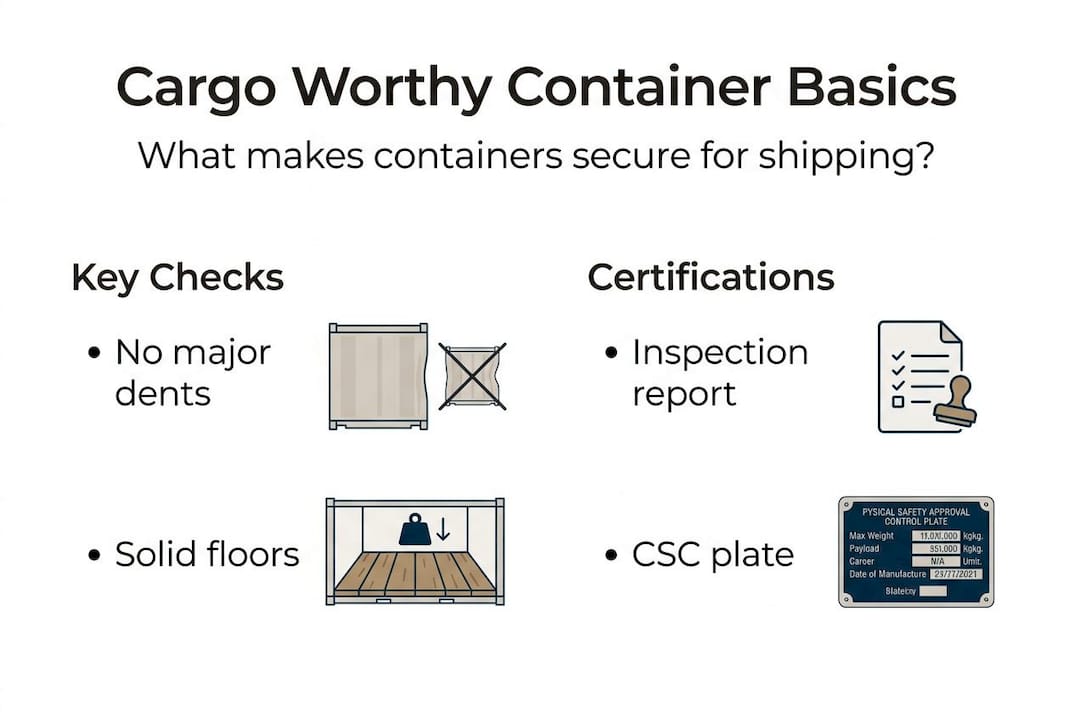
- Structural inspection: The frame, corner castings, and side panels are checked for deformation, cracks, or corrosion that would compromise load-bearing capacity.
- Floor inspection: Wooden or steel floors are tested for rot, damage, or weakness that could cause cargo to shift or fall through.
- Door and seal check: Doors must open, close, and lock properly. Gaskets must be intact to prevent moisture entry.
- Roof and wall check: No holes, significant dents, or rust-through that would expose cargo to weather.
- CSC plate verification: The container must have a valid Container Safety Convention (CSC) plate, which is the internationally recognized proof of fitness for transport.
Here is how the grades compare across key compliance categories:
| Feature | Cargo worthy | Wind and watertight | As-is |
|---|---|---|---|
| International shipping | Yes | No | No |
| Formal inspection required | Yes | No | No |
| CSC plate required | Yes | No | No |
| Insurance eligible | Yes | Limited | Rarely |
| Domestic storage use | Yes | Yes | Yes |
For businesses focused on improving container storage flow, knowing these compliance levels helps you plan which containers go into your supply chain versus which ones stay on-site. If you need to understand how container depots and security factor into compliance, that resource covers the full picture.
Benefits of cargo worthy containers for businesses and individuals
Understanding the regulations, it's time to explore why cargo worthy containers are in demand and what benefits they provide for diverse users.
The most obvious benefit is eligibility for international shipping. If your business exports goods, only cargo worthy containers will be accepted by freight carriers and port terminals. No certification means no loading, regardless of how solid the container looks.
Beyond shipping, cargo worthy containers offer a range of practical advantages:
- Insurance coverage: Shipping insurers require cargo worthy certification before they will cover goods in transit. Without it, a single incident could leave you absorbing the full loss.
- Structural reliability: Verified structural integrity and safety means your goods, equipment, or materials are protected against collapse, moisture, and forced entry.
- Resale value: Certified containers hold their value better than uncertified units. If you decide to sell later, a valid cargo worthy certificate is a selling point that commands a higher price.
- Repurposing flexibility: Cargo worthy containers are the preferred starting point for conversions into offices, workshops, or retail spaces because their structural soundness is already verified.
- Reduced rejection risk: Cargo worthy containers reduce the risk of shipment rejection by over 90% compared to uncertified containers, which translates directly to fewer delays and lower logistics costs.
For businesses storing heavy equipment or machinery, secure equipment storage in a cargo worthy container provides peace of mind that a WWT unit simply cannot match. Individuals looking at residential container options also benefit because cargo worthy units offer better long-term durability for home storage or backyard workshops.

The bottom line is that cargo worthy certification is not just a shipping requirement. It is a quality signal that benefits any use case where durability and security matter.
How to evaluate and purchase a cargo worthy container
Knowing the benefits, here's what you need to know when buying a cargo worthy container and how to protect your investment.
Start with a physical inspection checklist. Even with a certificate in hand, a walk-around inspection protects you from buying a container that has deteriorated since its last evaluation:
- Check all four corners for rust, cracks, or deformation
- Open and close every door, testing the locking bars and gaskets
- Walk the floor looking for soft spots, holes, or warped boards
- Inspect the roof from above if possible, or use a flashlight inside to spot light coming through
- Verify the CSC plate is present, legible, and not expired
Requesting inspection certificates can help buyers avoid costly mistakes, especially when purchasing remotely or from a reseller who did not perform the original inspection.
Here is a cost comparison to help you budget:
| Container grade | Typical price range (20ft) | Shipping eligible | Best use |
|---|---|---|---|
| Cargo worthy | $2,800 to $4,500 | Yes | Freight, storage, conversion |
| Wind and watertight | $1,800 to $3,200 | No | On-site storage |
| As-is | $800 to $1,800 | No | Non-critical uses |
| One-trip | $4,500 to $6,500 | Yes | Premium storage, export |
Documentation you should always request includes the inspection report with the inspector's credentials, the CSC plate number, any repair history, and the container's manufacturing date. For tips on managing container cost savings without sacrificing quality, that resource walks through where buyers commonly overpay.
If you are still deciding between ownership and leasing, the rent vs. buy containers guide helps you run the numbers for your specific situation.
Pro Tip: Always verify the seller's credentials and ask whether they sourced the container directly from a shipping line. Direct-source containers typically have cleaner histories and more reliable certifications than units that have passed through multiple resellers.
Why most buyers undervalue cargo worthy certification
Here is something that most container guides will not tell you: the majority of buyers who regret their purchase did not lose money on the price. They lost money on what happened after.
A denied insurance claim on a $40,000 shipment because the container lacked valid certification is far more expensive than the $500 difference between a WWT and a cargo worthy unit. We see this pattern repeatedly. Buyers focus on the upfront cost and skip the certification question entirely.
The other common mistake is treating cargo worthy as a one-time checkbox. Certification has an expiration dimension. A container that was cargo worthy five years ago may no longer meet current standards without a re-inspection. Savvy buyers track this and use it as a negotiation point.
True cargo worthy status is a long-term asset, not just a shipping formality. Watching container market ROI trends confirms that certified containers consistently outperform uncertified ones in resale scenarios. The certification is not just paperwork. It is proof of value.
Find certified cargo worthy containers with America Conex
Ready to invest in a cargo worthy container? Here's how you can proceed with confidence.
At America Conex, we supply inspected, certified cargo worthy containers for businesses and individuals across the United States. Every container in our inventory is evaluated for structural integrity, door function, and CSC compliance before it reaches you.
With over 30 depot locations nationwide, we deliver fast and competitively priced containers whether you need one unit for secure storage or a fleet for active freight operations. Our team guides you through documentation, sizing, and delivery logistics so there are no surprises. Explore our certified cargo worthy containers and get a quote today.
Frequently asked questions
How is a cargo worthy container different from a standard container?
Cargo worthy containers are certified for international shipping, while standard containers may not meet the strict transport and safety requirements that freight carriers and insurers demand.
Can I use a cargo worthy container for residential storage?
Yes, cargo worthy containers provide verified structural integrity and weather resistance, making them a reliable choice for secure home or business storage.
What documents should I request when buying a cargo worthy container?
Always ask for inspection reports, the CSC plate number, and certification documents. Requesting inspection certificates protects you from purchasing a container that no longer meets cargo worthy standards.
Is cargo worthy certification required for international cargo shipping?
Yes, cargo worthy certification is essential because ISO standards for shipping require it for containers to be accepted at ports and covered by freight insurance.