

TL;DR:
- Properly chosen accessories enhance shipping container security, moisture control, and usability on the ground. The most effective options include layered lock systems, cross-flow ventilation, and non-destructive mounting solutions tailored to specific needs. Prioritizing installation timing and maintenance considerations prevents costly future modifications and operational issues.
Bare shipping containers are built to survive ocean crossings, but without the right accessories, they fall short as practical storage or workspace solutions on U.S. soil. Selecting the top shipping container accessories before your container arrives is one of the most consequential decisions you can make. The right choices affect security against theft, moisture control that protects your contents, and daily usability whether you're a homeowner using a container for backyard storage or a contractor running a job site. This guide walks through what actually matters and why.
Table of Contents
- Key criteria for choosing shipping container accessories
- Top security accessories: lock boxes, padlocks, and crossbar locks
- Ventilation and condensation control accessories
- Interior organization and mounting solutions
- Comparing top shipping container accessories side-by-side
- How to choose the right shipping container accessories for your needs
- Reevaluating the must-have container accessories: a practical outlook
- Explore top-quality shipping containers and accessories at America Conex
- Frequently asked questions
Key Takeaways
| Point | Details |
|---|---|
| Layered security | Combining a hardened padlock with a welded or bolt-on lock box creates a robust physical barrier against theft. |
| Moisture control | Installing cross-flow vents and using moisture absorbers early prevents damaging condensation inside containers. |
| Non-destructive mounting | Container nuts compatible with ISO pockets enable secure accessory installation without drilling or welding. |
| Interior organization | Shelving and racking kits designed for corrugated walls transform empty containers into efficient storage spaces. |
| Plan early | Addressing security, ventilation, and leveling before delivery avoids common problems and costly retrofits. |
Key criteria for choosing shipping container accessories
Not all accessories deliver equal value. Before browsing any shipping container accessories list, use these four criteria to filter your options and avoid buying things that look useful but don't solve real problems.
Security effectiveness comes first. Your accessories need to work together as a layered system, not as isolated solutions. A padlock alone is not enough. Think about what the lock is mounted to and whether a grinder or pry bar could bypass it in under a minute.
Moisture and ventilation control ranks just as high for most users. Condensation risks arise fast, often before any visible damage appears, making ventilation one of the smartest early investments.
Installation method matters more than most buyers realize. Welded accessories offer permanence. Non-destructive bolt-on or ISO pocket mounting preserves the container's structural integrity and corrosion protection, which is important if you plan to resell or relocate the unit later. Understanding essential container features before you buy helps you match accessories to your specific container grade.
Daily usability is the fourth factor. Organization and leveling accessories reduce the friction of using your container every day.
Here are the four evaluation areas at a glance:
- Security: Lock type, mounting method, layered defense
- Ventilation: Cross-flow placement, supplemental moisture absorbers
- Installation: Welded vs. bolt-on vs. non-destructive mounting
- Usability: Shelving, racks, leveling pads, and access hardware
Notably, security hardware, ventilation, and leveling are the most wished-for upgrades before container delivery because of their immediate operational impact.
Top security accessories: lock boxes, padlocks, and crossbar locks
Security is the first thing most buyers think about, and for good reason. A standard container handle offers minimal protection on its own. The best shipping container tools for security work as a system.
Lock boxes are steel housings that surround your padlock, shielding it from bolt cutters and pry bars. Lock boxes shield padlocks from direct attacks and are installed either welded to the door or bolted on for a non-destructive option. Welded units are harder to remove but permanent. Bolt-on versions suit renters or users who may relocate the container.
Padlocks are not all equal. Hardened steel, closed-shackle, or monoblock designs are what you want here. A cheap padlock in an expensive lock box is still a weak point. Pairing a hardened padlock with a lock box significantly improves resistance against physical attack.
Crossbar locks span the full width of the container door externally, engaging the locking rods along the door's length. They are highly visible, which deters opportunistic theft, and they require specialty tools to defeat. Think of them as a supplement to, not a replacement for, a good padlock and lock box setup.
Key security accessories to consider:
- Welded lock box with hidden shackle padlock
- Bolt-on lock box for non-permanent installations
- Monoblock padlock rated for outdoor use
- Crossbar lock for high-value contents or vulnerable locations
Pro Tip: Explore lock boxes and padlocks alongside top secure locks before committing. The combination of lock box plus a quality padlock costs less than a single insurance claim from a break-in.
Ventilation and condensation control accessories
Steel containers trap heat and humidity. The temperature differential between the inside and outside generates condensation that can rust interior walls, damage stored goods, and promote mold. This is the problem most first-time container owners underestimate.
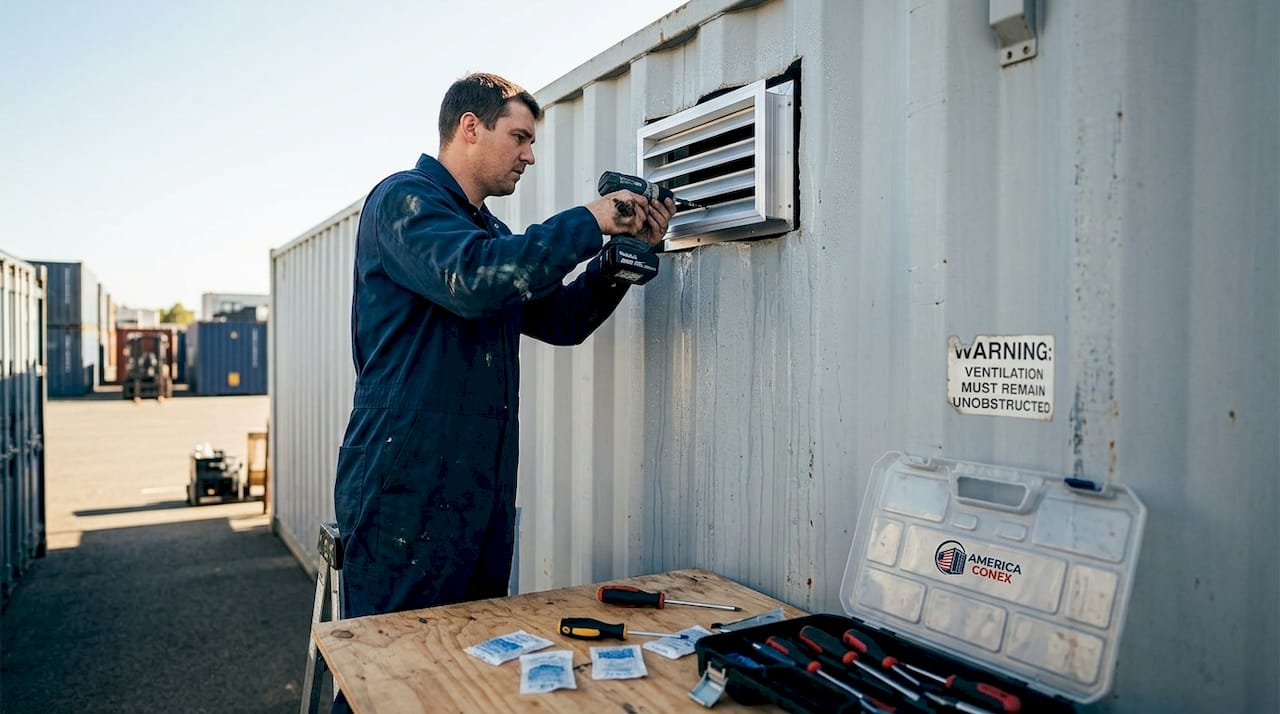
Standard factory vents are often insufficient; cross-flow ventilation with vents placed on opposite walls is the recommended approach. The idea is simple: air enters on one side and exits on the other, reducing stagnant moisture pockets. Louver-style vents are the most common upgrade, and they are available in weld-on or bolt-on configurations.
Desiccants fill the gap when active airflow is not enough. Silica gel packets work for smaller containers or lighter use. Calcium chloride damp sticks absorb significantly more moisture and are better suited for humid climates like the Gulf Coast or Pacific Northwest. Place them near the floor where moisture tends to collect first.
Moisture problems can arise before you have a chance to act, which is why addressing condensation control before your container is loaded is far smarter than treating visible damage after the fact.
Ventilation accessories worth adding:
- Louver vents, placed on opposite walls for cross-flow
- Turbine roof vents for passive convection in warmer climates
- Calcium chloride damp sticks for high-humidity environments
- Silica gel packets for seasonal or low-traffic containers
Pro Tip: If you are converting a container into a workspace or shipping container home, insulation combined with cross-flow ventilation is not optional. It is the baseline for a livable interior.
Interior organization and mounting solutions
Once security and moisture are handled, the focus shifts to making the interior actually functional. Most containers arrive as an empty steel box with no shelving, hooks, or organization whatsoever. That is both a challenge and an opportunity.
Wall-mounted shelving and racks designed for corrugated container walls give you usable vertical space. Shelving and racking kits improve interior usability since containers provide almost no built-in organization options. Horizontal shelving works well for boxes and bins. Vertical racks suit tools, lumber, or long equipment.
Freestanding racks offer flexibility since they require no wall attachment and can be moved around. The trade-off is floor space. In a 20ft container, freestanding racks can eat into the usable footprint quickly.
Container nuts are a category most buyers have never heard of, but they solve a real problem. ISO pocket compatible container nuts allow mounting accessories without drilling, preserving the container's corrosion protection and making installation genuinely reversible. They fit into the existing corrugation pockets in the container walls and accept standard bolt hardware. This is especially valuable for shipping container modification kits used in home or office conversions.
| Accessory | Mounting method | Best for | Reversible |
|---|---|---|---|
| Wall-mounted shelving | Bolted or welded | Fixed storage setups | Partially |
| Freestanding racks | Floor standing | Flexible, heavy loads | Yes |
| Container nuts | ISO pocket (no drilling) | Damage-free mounting | Yes |
| Hook strips | Screwed or adhesive | Light tools, gear | Yes |
Pro Tip: Explore interior organization options if you frequently access your container. Poor layout costs you time every single day. And if you want to keep costs down, consider mounting accessories without drilling before committing to welded solutions.
Comparing top shipping container accessories side-by-side
Here is a direct comparison of essential shipping container supplies across the main accessory categories to help you decide what fits your use case.
| Accessory | Installation | Pros | Cons | Ideal use |
|---|---|---|---|---|
| Welded lock box | Permanent weld | Highest security | Not reversible | High-value storage |
| Bolt-on lock box | Bolt-on | Flexible, removable | Slightly less secure | Rental or mobile use |
| Crossbar lock | No install needed | Visual deterrent | Adds time to access | Additional layer |
| Louver vent | Weld or bolt | Passive, reliable | Requires placement planning | All containers |
| Calcium chloride damp stick | No install | Passive moisture control | Needs regular replacement | Humid climates |
| Wall shelving | Bolted | Maximizes vertical space | Semi-permanent | Fixed storage |
| Container nuts | ISO pocket | Non-destructive, reversible | Load limits apply | Conversions, home use |
Layered security combining locks and lock boxes offers optimum protection, and ventilation and leveling accessories are commonly the most critical for early container setup. A thorough container accessory comparison like this one should be part of your planning process before you spend anything.
How to choose the right shipping container accessories for your needs
The right accessories for a homeowner storing garden equipment differ sharply from what a contractor needs on a job site. Here is a practical decision process.
- Assess your security risk. What are you storing, and where is the container located? High-value tools on a remote job site need welded lock boxes and monoblock padlocks. A backyard container with seasonal items can use a bolt-on setup. Matching lock strength to asset value and location risk is critical in selection.
- Evaluate your local climate. Humid coastal or southern states require more aggressive ventilation and desiccant solutions than dry inland locations.
- Decide on installation permanence. If you plan to move the container or sell it, non-destructive mounting solutions protect your investment.
- Plan your interior layout before you buy accessories. A container used as a workshop needs different organization than one used purely for storage.
Key questions to guide your final decisions:
- Will contents be accessed daily or seasonally?
- Is the container on a permanent foundation or a temporary site?
- Do you need a container that can qualify for a second sale later?
- Are you planning a full conversion into living or office space?
Pro Tip: Review choosing container accessories by intended use case. The accessories that make sense for what to include in shipping containers on a job site are not always the same ones that make sense for a shipping container home accessory setup.
Reevaluating the must-have container accessories: a practical outlook
Here is the honest truth most accessory guides skip: the biggest regrets container owners report are not about choosing the wrong brand of padlock. They are about timing and sequence.
Most container users wish security hardware, ventilation, and leveling were addressed before delivery, because retrofitting these items after the container is loaded, placed, and in active use is significantly harder and more expensive. Getting a welder out to install a lock box after your container is full of equipment is a hassle that most buyers did not anticipate.
The other underappreciated issue is the long-term cost of invasive modifications. Every drill hole and weld point that is not done correctly becomes a rust entry point. Avoid drilling and welding where possible to preserve corrosion protection and keep future modifications simple. Container nuts and bolt-on accessories are not compromise solutions. For most use cases, they are the smarter choice.
We also see buyers spend heavily on organization accessories while completely ignoring leveling. An uneven container means doors that are difficult to open, water pooling near the threshold, and long-term structural stress on the frame. Leveling pads or jack stands are cheap relative to the problems they prevent.
Explore cost-effective container upgrades before finalizing your accessory list. Spending a few hundred dollars on the right accessories upfront consistently outperforms spending several thousand on damage repair or operational headaches six months later.
Explore top-quality shipping containers and accessories at America Conex
Finding the right container is the first step. Equipping it properly is what makes it work for your specific situation.
At America Conex, we supply new and used shipping containers for sale across the U.S. from over 30 depot locations, which means fast delivery and competitive pricing no matter where you are. Whether you need a 20ft used WWT unit for backyard storage or a one-trip 40ft high cube for a construction office, we have the right option. Browse our available container grades and container dimensions to match the right unit to your project. Our team can also guide you on the accessories that fit your container grade and intended use from day one.
Frequently asked questions
What is the most secure padlock type for shipping containers?
Hardened steel padlocks with a hidden shackle or monoblock construction offer the highest resistance to cutting and prying. Hidden shackle and monoblock padlocks provide superior cut and drill resistance compared to standard open-shackle designs.
How can I prevent condensation inside my shipping container?
Install cross-flow ventilation vents on opposite walls and consider using moisture absorbers like silica gel or calcium chloride damp sticks. Cross-flow ventilation and desiccants effectively reduce moisture buildup before it causes damage.
Is it better to weld or bolt security accessories to my container?
Welding provides a more permanent and tamper-resistant installation, but bolt-on options avoid container damage and allow easier replacement. Weld-on lock boxes offer higher security permanence, while bolt-on options provide versatility without altering the container permanently.
Can I mount accessories without drilling or welding my container?
Yes, using ISO pocket compatible container nuts allows mounting brackets and accessories securely without drilling or welding. ISO pocket compatible container nuts enable non-destructive accessory installation that is fully reversible.
What accessories improve daily usability inside a container?
Shelving, racking kits, and storage add-ons like hooks and divider walls help organize the interior space effectively. Shelving and racking kits maximize interior usable surfaces and make frequent access far more practical.