

TL;DR:
- Shipping container sizes follow international ISO standards for compatibility and safety.
- Internal dimensions determine cargo fit, while external sizes affect site access and compliance.
- Choosing modular, flexible containers and considering delivery logistics optimizes cost and future growth.
Picking the wrong shipping container size is more common than most people realize, and it can cost you real money. A contractor who orders a 40ft high cube without checking overhead clearance at the job site ends up paying for a redelivery. A farmer who grabs a 20ft unit to store bulk feed runs out of room by month two. The right container size touches everything from loading efficiency and freight costs to site access and local regulations. This guide breaks down the official standards, internal dimensions, payload limits, and real-world selection strategies so you can make a confident, cost-effective decision the first time.
Table of Contents
- Understanding shipping container size standards
- Dimensions and capacities: Making sense of the numbers
- Choosing the right container for your application
- Special types and U.S. exceptions
- The missing variable: Local logistics and future flexibility
- Get reliable shipping containers delivered fast
- Frequently asked questions
Key Takeaways
| Point | Details |
|---|---|
| ISO standards matter | Standardized sizes ensure compatibility, safe handling, and easier cross-border shipment planning. |
| Internal volume varies | Actual usable space depends on internal dimensions—always check both cubic feet and payload limits before buying. |
| Consider special U.S. types | 53ft containers and non-ISO variants are vital for rail and specialized projects, but aren’t suitable for ocean shipping. |
| Site access is critical | Container size impacts delivery and placement; plan for enough run space and clearance, especially for high cube models. |
| Plan for flexibility | Adaptability and future expansion beat maximizing volume upfront for most business and storage needs. |
Understanding shipping container size standards
Before you compare prices or call a supplier, you need to understand what the numbers actually mean. Container sizes are not random. They follow a global framework that keeps cargo moving efficiently across ships, trains, and trucks worldwide.
What ISO standards actually do
ISO stands for the International Organization for Standardization. When it comes to containers, ISO 668 standards define the exact external dimensions and corner casting positions that allow containers to stack safely on vessels, lock onto chassis, and transfer between modes of transport without modification. If a container does not meet ISO specs, it cannot be used for ocean freight. That single fact eliminates a lot of confusion about why certain sizes exist and others do not.
Compliance with ISO also matters for safety. Stacking non-compliant containers creates structural risk. For buyers in the U.S., understanding this distinction helps you recognize which containers are suitable for international shipping and which are strictly for domestic storage or rail use.
External vs. internal dimensions: why both matter
Most buyers focus on the external length, which is what gives containers their common names: 20ft, 40ft, and so on. But the external measurement is not the space you actually use. The walls, floor, and ceiling take up real room. Per ISO 668, a standard 20ft container has external dimensions of 19'10.5" long, 8' wide, and 8'6" tall. A 40ft container is 40' long with the same width and height options. High cube (HC) variants add one extra foot of height, bringing the exterior to 9'6".
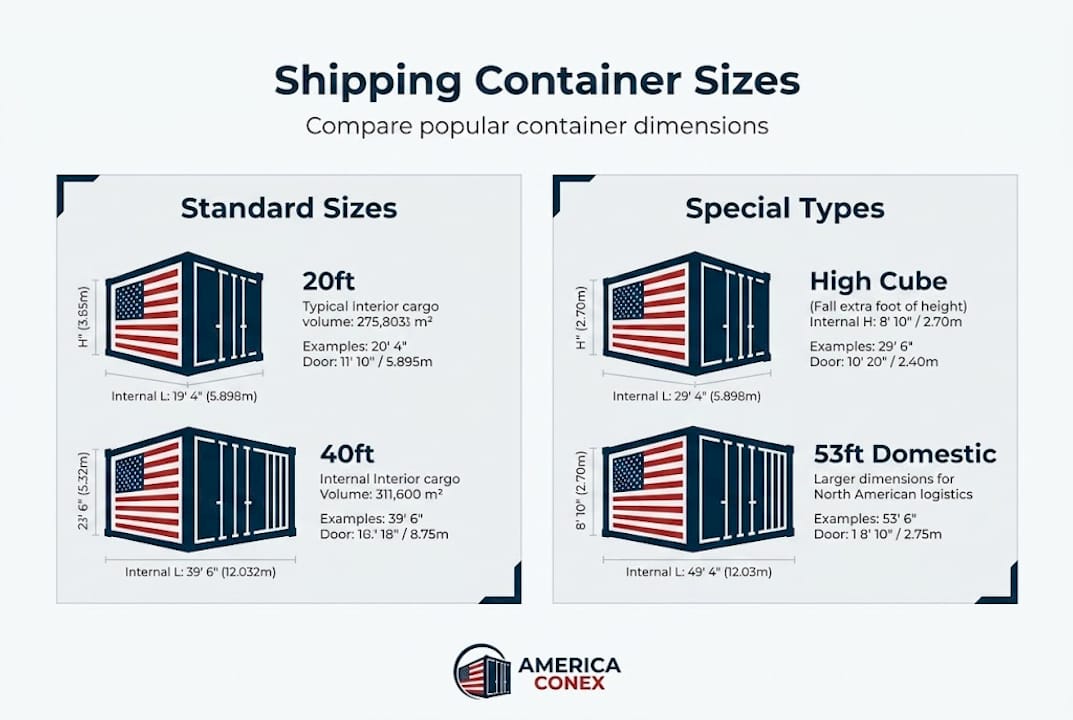
That extra foot of height in a high cube sounds minor until you realize it adds roughly 300 cubic feet of usable interior space in a 40ft unit. That is significant for light, bulky cargo. However, it also means the container is taller than standard units, which creates clearance challenges under bridges, power lines, and loading dock overhangs.
Quick size comparison
| Container type | External length | External width | External height | Approx. internal volume |
|---|---|---|---|---|
| 20ft standard | 19'10.5" | 8' | 8'6" | ~1,170 cu ft |
| 40ft standard | 40' | 8' | 8'6" | ~2,390 cu ft |
| 40ft high cube | 40' | 8' | 9'6" | ~2,690 cu ft |
| 53ft domestic | 53' | 8'6" | 9'6" | ~3,000+ cu ft |
Key facts to keep in mind when reviewing this table:
- High cube containers require extra overhead clearance during delivery and at the storage site
- The 53ft size is not ISO compliant and cannot be used for ocean shipping
- External width is consistent across ISO types, which simplifies chassis and rail compatibility
- Internal dimensions are always smaller than external ones, typically by 4 to 6 inches per dimension
Pro Tip: Always request both internal and external measurements from your supplier before purchasing. The external length names the container, but the internal dimensions determine whether your cargo actually fits.
Reviewing a standard containers guide before you buy can help you avoid the most common sizing mistakes buyers make when ordering for the first time.
Dimensions and capacities: Making sense of the numbers
With the standards in mind, let's turn the raw numbers into decisions you can actually use.
Internal dimensions and cubic volume
The table below shows the internal specs that matter most when you are planning a load or designing a storage layout.
| Container type | Internal length | Internal width | Internal height | Cubic volume | Max payload |
|---|---|---|---|---|---|
| 20ft standard | 19'4" | 7'8" | 7'10" | ~1,170 cu ft | ~47,900 lbs |
| 40ft standard | 39'5" | 7'8" | 7'10" | ~2,390 cu ft | ~59,040 lbs |
| 40ft high cube | 39'5" | 7'8" | 8'10" | ~2,690 cu ft | ~58,600 lbs |
| 53ft domestic | 52'6" | 8'6"–9'2" | 9'–9'6" | ~3,000+ cu ft | ~45,000 lbs |
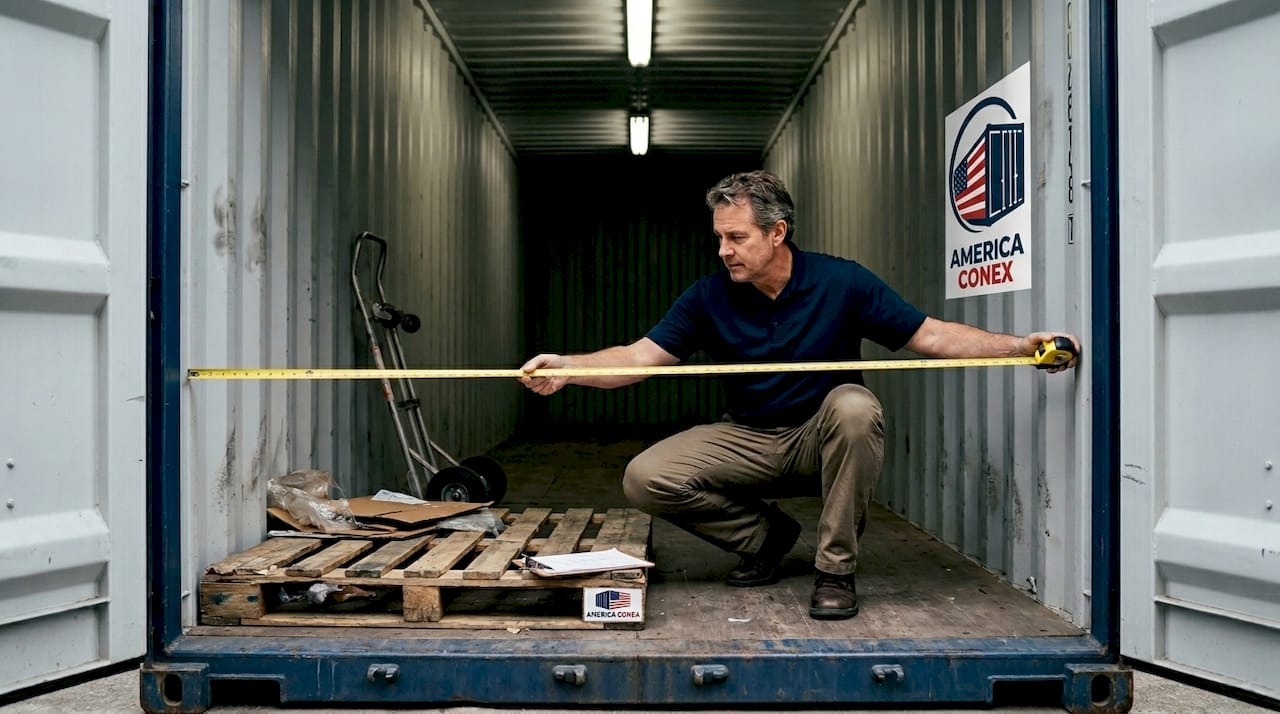
Internal dimensions confirm that the 40ft standard gives you more than double the floor space of a 20ft, which matters enormously for cargo that cannot be stacked. Think wide farm equipment, retail display fixtures, or flat-pack building materials.
Matching cargo types to container sizes
Here is how common U.S. cargo types align with container sizes:
-
Agricultural products in bulk bags or pallets. A 20ft container holds up to 10 standard pallets in a single row, or 11 with careful arrangement. A 40ft holds 20 to 21. If you are moving grain in super sacks or bagged fertilizer, the 40ft standard is usually the most cost-efficient option per unit of cargo.
-
Retail merchandise and packaged goods. Light, boxed products benefit from the extra height of a 40ft high cube. You can stack cartons higher without hitting the ceiling, which means fewer trips and better use of cubic volume. Many importers of consumer goods default to the 40ft HC for exactly this reason.
-
Contracting equipment and tools. Heavy machinery hits weight limits before it fills space. A 20ft container is often the smarter pick for dense, heavy cargo like steel beams, concrete forms, or engine blocks because you reach the payload ceiling long before the floor is covered. Trying to cram that same load into a 40ft often means paying for unused space.
-
Domestic freight by rail or truck. The 53ft domestic container is the workhorse of U.S. inland logistics. With a payload capacity of roughly 45,000 lbs and interior dimensions wide enough for standard U.S. pallet sizes, it maximizes efficiency on domestic rail corridors. However, it cannot go on an ocean vessel.
Why misjudging capacity is expensive
Exceeding a container's payload limit is not just a logistical problem. It creates liability, can void insurance coverage, and risks structural failure during transport. On the flip side, under-loading an oversized container means you are paying for cubic feet you are not using. Reviewing container capacities before committing to a size can save you from both scenarios.
A good rule of thumb: if your cargo is heavy and dense, size down. If it is light and bulky, size up or go high cube.
Choosing the right container for your application
Now, let's match these sizes to your practical needs, from straightforward storage to specialized U.S. applications.
Factors that drive the right choice
Before you lock in a size, work through this checklist:
- Cargo density. Dense, heavy cargo fills weight limits before volume limits. Light, bulky cargo fills volume first.
- Site access. A 20ft container needs about 30ft of run space for delivery, while a 40ft needs roughly 50ft. A high cube adds height constraints that can block delivery under low-clearance obstacles.
- Local regulations. Some municipalities restrict container placement, require permits, or limit the size of units on residential or agricultural land.
- Overhead clearance. High cube containers are 9'6" tall externally. Factor in the delivery truck height when calculating whether your site can accommodate them.
- Door access. Standard containers open from one end. If you need side access for forklifts or wide equipment, you may need an open-side variant.
- Future growth. Will your storage or shipping needs expand? Ordering modular units now can save you from costly upgrades later.
"The most overlooked factor in container selection is not size or weight. It is the delivery path. A container that cannot be delivered to your site is useless regardless of its specs. Always walk the route before you order."
Pro Tip: Before ordering any high cube container, measure the lowest point on your delivery route, including tree branches, utility lines, and dock overhangs. A standard flatbed truck with a high cube container can reach 13'6" to 14' in total height.
Specialized formats for U.S. buyers
For contractors, retailers, and farmers, the standard 20ft and 40ft units cover most needs. But some applications call for specialized formats. Open-side containers give you full-length access along the side wall, which is ideal for loading wide equipment or merchandise that cannot enter through a standard end door. Refrigerated units (reefers) maintain temperature-controlled environments for perishable agricultural goods or pharmaceutical products.
Reviewing your transport options early in the planning process helps you avoid ordering a container that your local carrier cannot legally or physically deliver. Pairing the right container type with a solid storage workflow also reduces loading time and labor costs significantly. For international moves, cargo worthy containers certified for ocean transport are the only acceptable option.
Special types and U.S. exceptions
Beyond standard sizes, let's look at the special containers that solve unique American challenges.
The 53ft domestic container
The 53ft container is an American invention designed for the U.S. rail and trucking network. It is wider and taller than ISO containers, which makes it incompatible with international ocean vessels. Its interior width of 8'6" to 9'2" accommodates standard U.S. pallet configurations better than the narrower ISO units, which were designed around European and Asian pallet standards.
Because 53ft containers cannot be loaded directly onto ocean ships, goods arriving from overseas in 40ft ISO containers must be transloaded into 53ft domestic units at port facilities before moving inland by rail or truck. This transloading step adds cost and time but is unavoidable given the size mismatch between ocean and domestic standards.
Specialized container formats worth knowing
Here is a breakdown of the most relevant non-standard formats for U.S. buyers:
- Open-side containers. Full-length doors on the side wall instead of just the ends. Ideal for contractors loading wide equipment, retailers receiving large merchandise, or anyone who needs forklift access along the full container length.
- Refrigerated containers (reefers). Self-contained refrigeration units that maintain precise temperature ranges. Essential for farmers shipping fresh produce, meat processors, or pharmaceutical distributors. Reefers require a power source at the storage site.
- Double-door containers. Standard end doors plus an additional set at the opposite end. Useful for drive-through loading where you need to load from one end and unload from the other without repositioning cargo.
- Open-top containers. No roof, which allows crane loading of oversized cargo like machinery, timber, or large agricultural equipment that cannot enter through standard doors.
- Flat-rack containers. Collapsible sides for extremely wide or irregularly shaped loads. Common in heavy construction and industrial equipment transport.
Agricultural and contracting applications
Farmers moving bulk commodities often find that standard ISO containers work well for packaged goods but fall short for loose bulk or oversized equipment. Open-top and flat-rack formats fill that gap. Contractors benefit most from equipment storage solutions that keep tools and materials secure on job sites without requiring a permanent structure. A 20ft standard unit placed on a job site is often the most cost-effective and secure option for this purpose.
The missing variable: Local logistics and future flexibility
Here is the perspective most container guides skip entirely: the spec sheet is not the hardest part of this decision. The hardest part is accounting for where your business will be in two years.
Most buyers treat container selection as a one-time optimization problem. They calculate their current cargo volume, match it to a size, and order. What they miss is that their needs will change. A retailer who starts with one 20ft unit for overflow inventory often needs three units within 18 months. A farmer who orders a single 40ft for equipment storage discovers that a second unit would double usable space without doubling cost.
The smarter approach is to think modularly from the start. Two 20ft containers cost slightly more than one 40ft but give you far more flexibility in placement, access, and future reconfiguration. You can position them in an L-shape, stack them, or move one to a second location. A single 40ft is fixed in its footprint.
Local logistics also deserve more weight than most buyers give them. A container that is technically the right size but cannot be delivered to your site without a crane or special permit is a problem you created by not asking the right questions upfront. Saving on container costs starts with avoiding expensive delivery complications, not just negotiating the purchase price.
The bottom line: buy for where you are going, not just where you are. Flexibility beats maximum capacity for most U.S. buyers.
Get reliable shipping containers delivered fast
Knowing the right container size is only half the equation. The other half is finding a supplier who can actually deliver what you need, when you need it, at a price that makes sense.
At America Conex, we supply new and used shipping containers in all major sizes, including 20ft and 40ft standard and high cube units, with access to over 30 depots across the country. Whether you need a one-trip container in like-new condition, a used wind and water tight unit for on-site storage, or a cargo worthy container certified for international shipping, we can match you with the right option. Browse our full inventory of shipping containers for sale and get a quote from a team that understands the difference between a spec sheet and a real-world delivery.
Frequently asked questions
What are the typical external dimensions of 20ft and 40ft shipping containers?
A 20ft container is about 19'10.5" long, 8' wide, and 8'6" tall in standard height or 9'6" in high cube. A 40ft container is 40' long with the same width and height options.
How much cargo can fit inside a 40ft standard container?
A 40ft standard container has internal dimensions of roughly 39'5" long, 7'8" wide, and 7'10" tall, giving you approximately 2,390 cubic feet of usable space.
Are 53ft containers used for international ocean shipments?
No. 53ft domestic containers are built for U.S. inland and rail transport only. ISO 20ft and 40ft containers are the standard for international ocean shipping.
What special shipping container types are available for unique needs?
Beyond standard units, you can choose from open-side, reefer, and double-door formats, each designed for specific loading, temperature, or access requirements in agricultural, contracting, and retail applications.