
TL;DR:
- Choosing ISO-compliant intermodal containers ensures seamless international transport, safety, and stacking compatibility.
- Non-ISO containers often lack crucial structural certifications and safety plates, risking delays and legal issues.
- Building compliance into procurement practices enhances supply chain reliability and long-term business competitiveness.
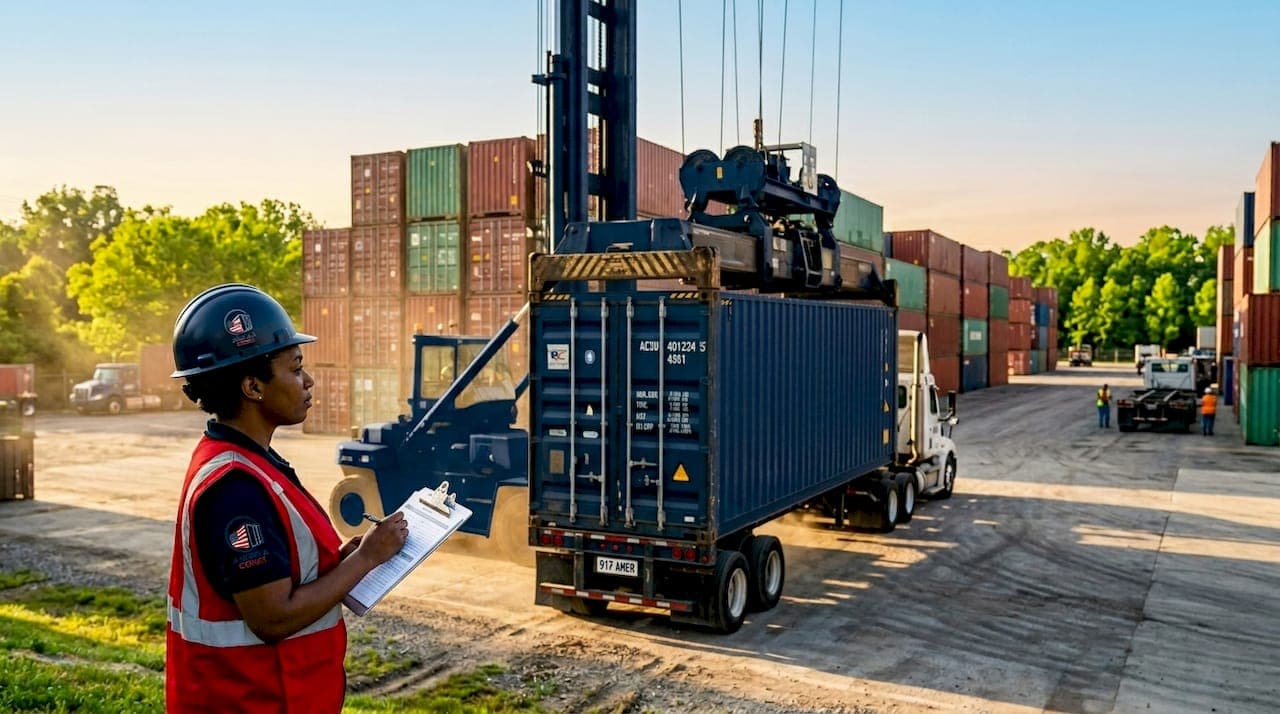
Most business owners assume that any steel shipping container can be loaded onto a ship, transferred to a rail car, then dropped onto a flatbed truck without missing a beat. That assumption costs time, money, and serious logistical headaches. The reality is that not every steel box qualifies for that kind of seamless, multi-mode transport. Intermodal containers are a specific category built around standardized dimensions, reinforced corner castings, and international safety certifications that allow a single unit to move across ocean, rail, and road without ever unloading the cargo inside. Understanding this distinction is the difference between a smooth supply chain and an expensive compliance problem.
Table of Contents
- What is an intermodal container?
- Standardization and global compatibility
- Safety regulations and international requirements
- Choosing and using intermodal containers for your business
- The hidden value of intermodal containers: what most businesses overlook
- Find the right intermodal container for your needs
- Frequently asked questions
Key Takeaways
| Point | Details |
|---|---|
| Intermodal containers streamline shipping | They allow for efficient transfer of cargo between ships, trains, and trucks without unloading. |
| ISO standards ensure compatibility | Over 95% of intermodal containers are ISO-certified, fitting global transport systems. |
| CSC plates required for international moves | Containers must have safety-approval plates to qualify for international shipping. |
| Proper selection boosts ROI | Sourcing compliant containers means greater supply chain efficiency and fewer workflow problems. |
| Not every container qualifies | Only ISO-compliant units with required safety plates should be used for global logistics. |
What is an intermodal container?
The term "intermodal" describes something that works across multiple modes of transport. Applied to containers, it means a single unit can travel by ship, rail, and truck without the cargo being transferred or repacked at any point during the journey. That last part matters enormously. Traditional freight required workers to unload goods at every transfer point, creating opportunities for damage, theft, and delays. Intermodal containers eliminated that problem entirely.
According to Wikipedia, an intermodal container is a standardized shipping container built to move cargo across multiple transport modes without unloading the cargo unit between modes. The "standardized" part is not just about size. It covers the precise placement of corner castings, the rated strength of the floor and sidewalls, and the structural integrity required to stack multiple loaded units six or seven high on a container ship.
Here are the key structural features that define a true intermodal container:
- Corner castings: Oval-shaped steel fittings welded at all eight corners, designed to accept twistlocks and spreader bars from cranes and reach stackers
- Twistlock compatibility: The locking mechanism that connects a container to a ship's deck, a rail car, or a truck chassis
- Standardized footprint: External dimensions that fit universally across global port infrastructure, rail systems, and road vehicles
- Structural load ratings: The ability to bear significant stacking loads, typically six fully loaded containers above it
- ISO compliance markings: Identification codes showing the container's registration, size, and type classification
Not every steel box marketed as a "shipping container" meets these criteria. A container might look identical on the outside but lack the rated corner castings or structural certifications that make it intermodal. Reviewing shipping container terminology before purchasing helps avoid this exact mistake. You can also get a clearer picture of what qualifies by reviewing standard containers explained.
| Feature | Intermodal container | Non-standard steel box |
|---|---|---|
| ISO-rated corner castings | Yes | Often no |
| Twistlock compatible | Yes | Rarely |
| Stackable under load | Yes (6+ units) | No |
| Eligible for international shipping | Yes (with CSC plate) | No |
| Fits universal port equipment | Yes | No |
"A container that looks sturdy enough for storage might not have the structural geometry to survive being lifted by a spreader crane or stacked on a vessel under full ocean swell conditions. Intermodal certification is not cosmetic. It is structural."
Standardization and global compatibility
Now that you know the basics, let's look at the standards that make intermodal containers globally compatible. The entire intermodal system depends on one foundational agreement: every container must fit every piece of handling equipment, everywhere in the world. That is an extraordinary engineering and logistical achievement, made possible by the International Organization for Standardization (ISO).
Most intermodal containers are built to ISO standards, which enables compatibility with global intermodal handling and transport equipment. These standards define external dimensions precisely, corner casting positions to the millimeter, and minimum structural ratings for floor loading, racking, and stacking. When a port crane in Los Angeles lifts a container, the spreader bar locks onto the same corner casting positions as a crane in Rotterdam or Shanghai. That universal fit is not accidental. It is engineered.
The two most common ISO container sizes you will encounter as a logistics manager are:
- 20ft standard (TEU): 20 feet long, 8 feet wide, 8.5 feet tall. The "twenty-foot equivalent unit" is the industry's baseline measurement for cargo volume.
- 40ft standard: Twice the cargo capacity of a TEU, ideal for high-volume domestic and international loads.
- 40ft high cube: Same footprint as a standard 40ft but one foot taller at 9.5 feet, giving more vertical storage space for lightweight, voluminous cargo.
Statistic callout: Industry data consistently shows that over 95% of intermodal containers in active global circulation comply with ISO standards. That near-universal adoption is precisely why a container sourced in the United States can be shipped to Europe and transferred seamlessly onto local rail and truck networks without any modification.
The comparison between ISO and non-ISO containers is not subtle. Non-ISO containers are built for static storage or limited domestic use. They lack the corner casting precision and load ratings required for terminal cranes, ship lashing systems, and rail car securement. Using a non-ISO unit for international transport is not just inadvisable. Most carriers and ports will refuse it outright.
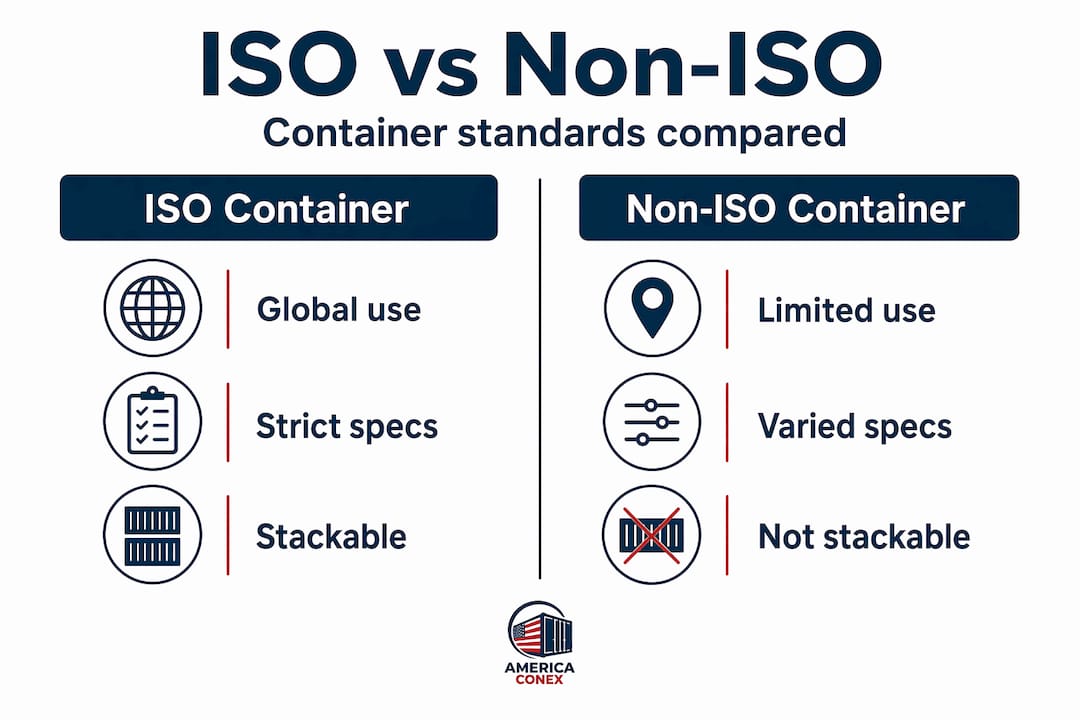
| Specification | ISO container | Non-ISO container |
|---|---|---|
| External length tolerance | ±3mm | Varies widely |
| Corner casting position | Precisely defined by ISO 1161 | Not standardized |
| Stack load rating | 192,000 kg (top fittings) | Unrated |
| Global port acceptance | Universal | Not accepted |
| Rail car compatibility | Full compatibility | Not compatible |
Pro Tip: When sourcing containers for international use, always ask the supplier for ISO certification documentation. A container listed as "cargo worthy" in the domestic market may not meet ISO structural ratings for international intermodal use. Cargo worthy containers do meet specific standards, but confirm the scope before purchasing for cross-border moves.
Safety regulations and international requirements
With global standards in place, safety and compliance become pivotal for international moves. ISO compliance handles dimensional and structural consistency. But there is a separate layer of legal requirement that covers what happens when containers move across international borders: the International Convention for Safe Containers, better known as the CSC.

For international shipping, containers are regulated under the CSC, and containers traveling internationally must be fitted with a CSC safety-approval plate. This plate is a physical metal tag riveted to the container, and it communicates critical safety data to every port authority, carrier, and inspection officer that interacts with the unit during its journey.
Here is what the CSC safety-approval plate includes:
- Country of approval: The nation that certified the container under CSC requirements
- Date of manufacture: The original build date, which determines inspection intervals
- Identification number: A unique unit identifier traceable across global shipping databases
- Maximum gross weight: The maximum permissible loaded weight the container can safely carry
- Allowable stacking load: The rated weight that can be stacked on top of the container while it is fully loaded
- Racking test force: Structural data showing the container's resistance to diagonal forces during ship movement
- Next examination date: The scheduled date for the next structural inspection to maintain certification validity
The step-by-step process for a container to earn and maintain CSC approval involves initial certification at manufacture, periodic physical inspections (typically every 30 months after the first five years), and immediate re-inspection following any significant impact or structural damage. Containers that fail inspection are removed from international service until repaired and recertified.
This is an important edge case for logistics managers: not every steel box marketed as an "intermodal container" automatically qualifies for international use. A container can be ISO-compliant in terms of its dimensions but still lack a valid CSC plate, either because it was never certified or because its certification has lapsed. Buying containers without verifying CSC status for international routes can result in your cargo being held at port, with demurrage fees accumulating daily.
"Always verify CSC plate validity before committing a container to an international route. A single rejected container can delay an entire shipment and trigger costly storage fees at the destination port."
Pro Tip: Build a simple container inspection checklist into your shipping workflow. Confirm ISO classification, CSC plate presence, and the next examination date before each international departure. Reviewing your container storage workflow is a practical way to integrate compliance checks into daily operations without adding friction to your logistics team.
Choosing and using intermodal containers for your business
With safety and standards addressed, here is how to select and utilize intermodal containers for your business needs. The right container choice depends on two things: what you are shipping and where it is going. Getting specific about both upfront saves significant cost and avoids compliance problems downstream.
The intermodal advantage is less about any special container feature in isolation and more about standardized geometry and strength points combined with securing hardware, like corner castings and twistlocks. This combination lets the same unit be lifted, stacked, and transferred by different carriers and terminal equipment across the entire journey. That operational continuity is what drives efficiency.
Here is what to assess when sourcing intermodal containers for your business:
- ISO compliance status: Confirm the container carries valid ISO classification markings and meets dimensional tolerances
- CSC plate validity: Essential for any international route. Check the next examination date, not just the presence of the plate
- Condition grade: One-trip containers offer near-new structural integrity; used cargo worthy units are certified fit for international shipping; WWT (wind and water tight) units are best suited to secure ground storage
- Size selection: Match the container size to your typical cargo volume. A 20ft TEU suits smaller, dense loads; a 40ft high cube suits large, lightweight loads
- Stackability rating: If your facility or port requires stacking, verify the unit's rated stack load before committing
How condition grades compare for intermodal use:
| Container type | Intermodal use | International eligible | Best for |
|---|---|---|---|
| One-trip (like-new) | Yes | Yes | High-value cargo, exports |
| Cargo worthy (used) | Yes | Yes | Regular import/export cycles |
| WWT (used) | Limited | No | Secure storage, domestic staging |
Pro Tip: For high-frequency international shipping routes, one-trip containers offer the lowest risk of mid-journey inspection failure. They carry full CSC certification and minimal structural wear, which reduces the probability of compliance holds at foreign ports. If budget is a priority, used cargo worthy containers are a cost-effective alternative for established shipping lanes.
On the operational side, intermodal containers create measurable business advantages. Cargo that stays sealed from origin to destination is significantly less exposed to damage and theft compared to freight that gets handled multiple times. Insurance claims drop. Product quality at delivery improves. Supply chain predictability increases because you are working with standardized units that fit every piece of handling equipment in the network. Learning more about your transport container options and container quality for storage will help you build a more reliable logistics operation from the ground up.
The hidden value of intermodal containers: what most businesses overlook
Let's step back and look at what most businesses get wrong. And more importantly, how you can gain a strategic edge by understanding what they miss.
The most common mistake is treating container selection as a commodity purchase. A container is a container, the thinking goes, so buy the cheapest available unit. That logic works fine for a fenced storage yard. It fails expensively the moment that container enters an international supply chain.
Here is the uncomfortable truth: the cost of a non-compliant container is almost never found at the point of purchase. It surfaces later, at the port, when customs officials flag a missing or expired CSC plate. It appears as demurrage fees while your cargo sits waiting for an inspection that may take days. It shows up as supply chain disruption when a major retail buyer's receiving window closes because your shipment arrived late.
The businesses that gain the most from intermodal containers are not necessarily the ones shipping the highest volumes. They are the ones who understand the compliance requirements deeply enough to build them into procurement decisions from the start. They buy cargo worthy or one-trip units with verified CSC plates. They track next examination dates. They know which container grades work for which routes.
There is also a stackability angle that most operators underestimate. When your facility stacks non-rated containers to save yard space, you are creating a structural risk that your insurance policy may not cover. Intermodal containers with proper stack load ratings give you documented structural capacity and reduce liability exposure significantly.
The 2026 container market trends point clearly toward tighter port inspections and more rigorous documentation requirements for international cargo. Businesses that invest in genuinely compliant intermodal units now are building supply chain infrastructure that will not require expensive remediation as regulations tighten. The long-term return on investment comes directly from compliance and reliability, not from chasing the lowest per-unit price.
Find the right intermodal container for your needs
Sourcing a compliant intermodal container should not require a logistics degree or weeks of research.
At America Conex, we supply new and used shipping containers that meet ISO and CSC standards for both domestic storage and international shipping. Our inventory includes one-trip containers, used cargo worthy units, and WWT containers in 20ft and 40ft standard and high cube sizes. With more than 30 strategically located depots across the United States, we deliver competitive pricing and reliable service no matter where your operation is based. Whether you are building out a long-haul export program or need secure on-site storage for a job site, our team helps you match the right container grade to your specific requirements from day one.
Frequently asked questions
What is the difference between an intermodal container and a regular shipping container?
Intermodal containers are ISO-standardized and designed to move across ship, rail, and truck without unloading, while regular shipping containers may lack these structural features and certifications.
Do all intermodal containers qualify for international shipping?
No. Only containers with ISO compliance and a valid CSC safety-approval plate are legally eligible for international transport under the International Convention for Safe Containers.
What information does a CSC safety-approval plate include?
A CSC plate lists container identification, the country of approval, maximum gross weight, allowable stacking load, and the next scheduled examination date for structural recertification.
How can businesses benefit from using intermodal containers?
Intermodal containers reduce cargo handling at every transfer point, which directly lowers damage rates, shrinks insurance claims, and improves supply chain reliability and delivery predictability.
Are there risks in buying non-ISO containers for global shipping?
Yes. Non-ISO containers are typically rejected by international ports and carriers, lack certified stackability, and can result in costly demurrage fees and cargo holds that disrupt your entire supply chain.